
Erasing Settlement Dwellers’ Embodied Weather Knowledge
In Korail, the largest urban informal settlement of Bangladesh, preparation for flooding is part of everyday life. One summer afternoon, I visited Shamol, my co-organizer in various mutual aid efforts in the settlement, and found his bed raised high on bricks. The air was hot and humid, with no sign of rain. I asked why he had gone to the trouble. He answered matter-of-factly, “It’s that time of the year. Just getting ready.” As part of my fieldwork, I regularly visited the settlement. A few days later, the rains arrived. The floor was under water. We sat on the raised bed, a few feet above the flood. The wet bricks held together a collective knowledge of how to endure the monsoon in the settlement. (Fieldwork, Second Author)
Shamol’s quiet expertise, honed across a lifetime of navigating the capricious hydrology of the informal settlement, surfaces a central paradox of climate discourse in urban South Asia: when does flooding that is anticipated and prepared for through embodied knowledge stop being ‘extreme’ and simply become weather? More crucially, who gets to decide where that threshold lies, and what political work does that labelling perform? At a grounded register, Shamol’s uncertainty lies elsewhere: when will the next wave of eviction notices come? Will this year's flooding justify new "beautification" schemes? Can the flooding be alleviated with better drainage? The real ‘extreme’ may be Korail’s precarious placement within Dhaka for decades, where the political calculus of tenure insecurity determines futures more decisively than any weather forecast.
For informal settlement dwellers, the seasonal rise of water is an anticipated rhythm, a reality to be navigated with skill and collective effort. For the state and its allied agencies, multilateral climate finance institutions, international NGOs and media, the same event can be an ‘unprecedented disaster,’ a spectacular breakdown of a system that is supposed to function normally. Such labelling stimulates a rupture that inaugurates ‘crisis-time’, bringing forth a parallel flood of ‘post-political’ (Swyngedouw, 2009) technocratic blueprints and redevelopment schemes. We understand the disjuncture between residents' lived rhythms and official crisis declaration emerging from the violent erasure of colonial/postcolonial histories, wetland enclosure and decades of infrastructural neglect to present climate vulnerability as a sudden, apolitical crisis. Everything that came before the rains vanishes out of frame. Anthropologist Camelia Dewan (2023) terms such a flattening of social relations in the context of environmental change “climate reductive translations”, where the complex socio-ecological and political entanglements of regions are laundered into tidy technical problems solvable through expert intervention rather than structural transformation. Climate reductive interventions also work through a corresponding scalar distortion. The planetary processes of climate change and the cyclical, regional patterns of the monsoon are flattened into the national spectacle of an ‘unprecedented’ event, which in turn authorises municipal interventions. The expertise of Korail’s residents (an intelligence attuned to regional rhythms and local topographies) is the first casualty of such distortion.
The discursive linkage of South Asian environments with inherent chaos and catastrophe is not a new script. As Hartmann (1995) has documented, the “population bomb” narrative once performed a similar trick. The Malthusian sleight of hand at work in the “population bomb” narrative blamed reproductive patterns amongst the poor, thereby pathologising the fertility of ‘natives’ for environmental degradation while letting the overconsumption of the rich and corporate plunder off the hook (Hartmann, 2010; 2014). The language of extreme weather is the population bomb discourse's climatic cousin, operating with strikingly similar logic. Focus narrows to unruly weather, away from the structural drivers of vulnerability, namely the historical land-use decisions and speculative development that filled wetlands. Put simply, the problem is framed as atmospheric when it is political. When placing environmental burdens squarely at the door of extreme weather, we naturalise disaster, obscuring how the built environment and social order overwhelmingly determine who gets wet and who stays dry. In Korail, the same lakefront that wealthy Gulshan residents adjacently wish to enjoy as scenic amenity becomes, across the water, a disaster-prone zone requiring clearance.
If Hartmann shows how previous crisis discourses pathologised bodies, Kasia Paprocki (2018) shows how crisis discourses structure contemporary interventions, describing how an “adaptation regime” now governs the landscape of possible intervention in the face of climate change. Financed by global climate funds demanding measurable crisis response, operationalised through national bureaucracies and justified by selectively folding regional weather patterns into narratives of unique national emergency, Paprocki describes how adaptation regimes operate through three interrelated processes: imagination, experimentation and dispossession. The framing of weather as “extreme” serves all three functions, situating urban areas at the receiving end of this scaled squeeze. Here, futures are imagined under the weight of inevitable climate catastrophe, only to be managed through technical solutions and urban-centric growth machines, foreclosing alternative agricultural or collectively managed futures. For the rural poor, adaptation regimes entail dispossession from agrarian livelihoods and forced outmigration, all in the name of a teleological development path toward urbanisation and export-led growth.
Political contests over a flood's cause determine where blame falls and what intervention follows. Our argument, then, is that labelling weather 'extreme' advances a specific project of urban climate governance which turns on a foundational refusal. The state acknowledges the material existence of floodwater but does not extend acknowledgment to the legitimacy of the lifeworlds that have co-evolved alongside it. The label 'extreme' executes a discursive shift where residents’ adaptive capacities are transposed into a register of crisis and disorder, a marker of illegitimacy when measured against the normative schematic of a sealed, flood-managed city. Consider a profound contradiction rooted in the translation of vulnerability across space. Many Korail residents migrate from Bangladesh’s increasingly climate-stressed deltas, mobility framed by mainstream development logics as rational adaptation. In Dhaka, they settle on some of the only land available to them on the margins of lakes and wetlands.
Hydrological literacies that climate-impacted migrants carry offer little protection within Bangladesh’s adaptation regime; rather, their skilled adaptations (dug drains and raised plinths) are recast as evidence of permanent, disruptive alteration, their ingenuity becoming proof of transgression against visions of a market-ready, hygienically aestheticised city. Through the collapsing of lived history into the stigmatised category of “slum dweller,” we see the working of a durable colonial episteme. The practice of mapping “disease-prone native quarters” to justify sanitary intervention has seamlessly updated its vocabulary, now mapping “disaster-prone slums” to justify clearance under the contemporary metacode of climate change (Doshi, 2019; Klein, 1986). Such postcolonial continuities cut to the heart of Bangladesh’s tortured “development question” saga (Osmani 2010), shaped in part by global adaptation funding that privilege technocratic solutions over community knowledge. Crisis discourse amplifies neocolonial logics, rendering certain bodies more governable and disposable under the guise of climate emergency.
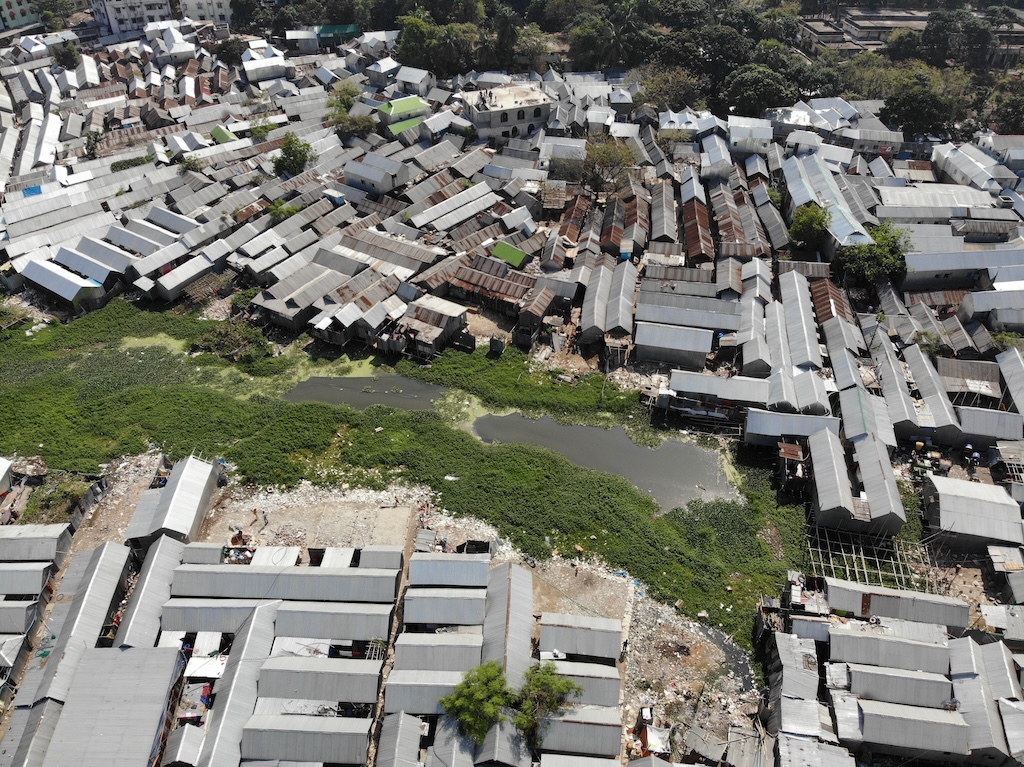

Returning to Korail, dwellers’ knowledge is not unique but part of a collective intelligence, a set of atmospheric expectations refined across generations and geographies. Its inhabitants read the coming rain through sensory networks (shared observation of clouds, wind, humidity and water) levels long before any official alert sounds. Residents’ collective intelligence is materially enacted in the narrow, hand-dug channels that trace the land’s gradient, guiding water from homes to lake. Yet it is not a uniform resource. The state's crisis-time bears down with decidedly uneven force. A new arrival from the silted-up coast may have neither the local knowledge nor the social networks that a long-term family with decades of negotiated foothold in the settlement, who oftentimes are able to better mobilise when eviction threats arrive. Their expertise (and vulnerability) is shaped by class, gender, origin and the fragile hierarchies of informal tenure.
Residents’ subtle engineering is both ingenious and perilously provisional, a form of iterative care that remains illegible to the state, dismissed as improvisation rather than recognised as legitimate adaptation infrastructure. But in rightly championing Korail's vernacular praxis, we must avoid the trap of romanticisation. To celebrate these improvised infrastructures without critique risks missing the everyday politics of informal settlements. Improvised infrastructures exist as responses to state abandonment, crafted from necessity and collective repair in the face of despair, while also being imbricated in granular everyday politics of inclusion and exclusion at local level. We must also guard against the state's own reading of residents’ environmental stewardship, which frames them as anachronistic vestiges of a potentially 'rural' or 'informal' habituation out of place in the modern, orderly city (Huq, 2024).
On this note, a fair rebuttal is that labelling weather “extreme” mobilises international aid and focuses humanitarian and political attention on urgent suffering. However, in Korail, this emergency framing has a consistent track record of prioritising short-term, techno-managerial solutions that often exacerbate long-term vulnerabilities (Shafique, 2024). Resources mobilised by crisis narrative bypass community knowledge and ultimately increase precarity. Aid arrives, but predicated on the idea of a helpless population waiting for rescue, not one actively stewarding its environment.
Yet for us, true extremity lies in the continued refusal to see Korail’s residents as embedded ecological knowledge holders. A more just climate urbanism would therefore start not only with new technologies to be imposed upon the settlement’s residents but by following their lead: integrating their infrastructures into city plans instead of demolishing them and recognising secure tenure as prerequisite for lasting adaptation. Our approach, set out here, moves beyond common ‘crisis’ narratives to engage with the temporalities of everyday crisis, centring the expertise born of weathering environmental shifts. This is a fight for epistemic justice. The path forward isn’t to manage the crisis of the extreme, but to learn from those for whom it has become weather.
References
Dewan, C. (2023) Climate refugees or labour migrants? climate reductive translations of women’s migration from coastal Bangladesh, The Journal of Peasant Studies, 50:6, 2339-2360.
Doshi, S. (2019). Greening displacements, displacing green: Environmental subjectivity, slum clearance, and the embodied political ecologies of dispossession in Mumbai. International Journal of Urban and Regional Research, 43(1), 112-132.
Hartmann, B. (1995). Reproductive rights and wrongs: The global politics of population control. South End Press.
Hartmann, B. (2010). Rethinking the role of population in human security. Global environmental change and human security, 193-215.
Hartmann, B. (2014). Converging on disaster: climate security and the Malthusian anticipatory regime for Africa. Geopolitics, 19(4), pp.757-783.
Huq, E. (2024). Green informalities as socially just ecological infrastructure: Enduring with dignity at the edges of resilient development in Dhaka. International Journal of Urban and Regional Research, 48(4), 560-583.
Klein, I. (1986). Urban development and death: Bombay City, 1870–1914. Modern Asian Studies, 20(4), 725-754.
Osmani, S. R. (2010). Realising the right to development in Bangladesh: progress and challenges. The Bangladesh Development Studies, 25-90.
Paprocki, K. (2018). Threatening dystopias: Development and adaptation regimes in Bangladesh. Annals of the American Association of Geographers, 108(4), 955-973.
Shafique, T. (2024). City of Desire: An Urban Biography of the Largest Slum in Bangladesh. Bloomsbury Publishing.
Swyngedouw, E. (2009). The antinomies of the postpolitical city: In search of a democratic politics of environmental production. International journal of urban and regional research, 33(3), 601-620.