
Seasonality, Labour and Urban Pollution in Bangladesh
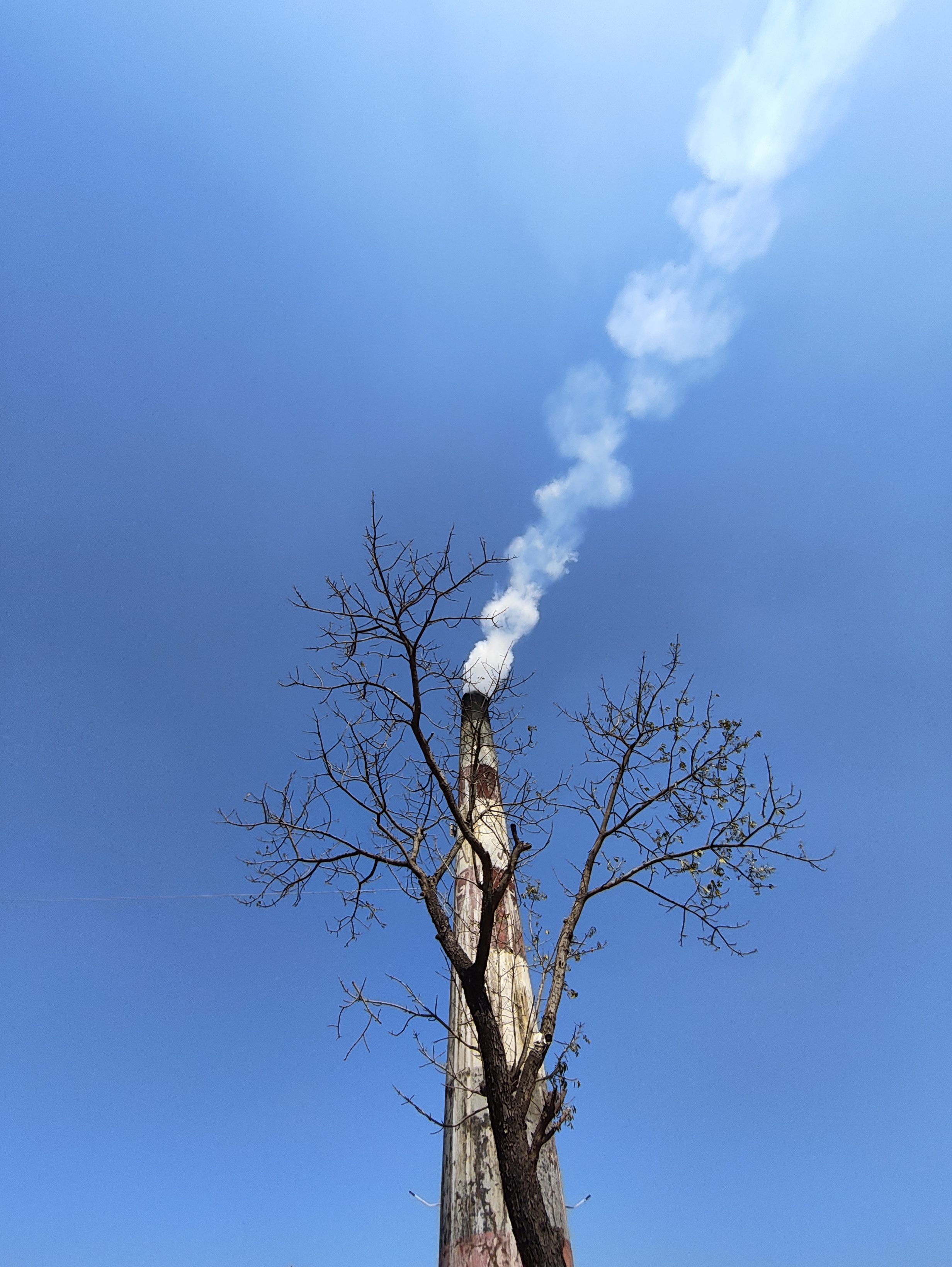

Dhaka, the capital of Bangladesh, is one of the world’s most polluted cities. This problem is connected to both Dhaka’s phenomenal expansion and the ways in which seasonality underpins processes of urban construction. In the dry season, Dhaka becomes more contaminated when atmospheric pollutants are not washed away by rain. Brickmaking takes place in the dry season as the process for making bricks relies on dry weather to dry the bricks before they are fired in the kiln. The burning of coal and wood to fire the bricks in the kiln creates particulate matter that spreads over neighbouring cities. In the past twenty years both the government and multi-lateral organisations, such as the World Bank and Asian Development Bank, have tried to reform brickmaking to reduce pollution through regulations and projects that introduce new technical, labour-saving, and cleaner technologies. These policies have met with mixed success. In 2024, the Interim Government’s Advisor on Environment, Forests, and Climate Change, Rizwana Hasan, announced a ban on government purchases of fired bricks and plans to close non-compliant brickfields. These techno-fixes and regulations are symptomatic of a failure to understand the political ecology of Dhaka’s pollution and brickmaking, and as such fail to understand the central role labour dynamics play in the use of polluting technologies and the ensuing seasons of extreme pollution. At its core, the brickmaking’s role in seasonal pollution in Bangladesh and across South Asia is a question of labour.
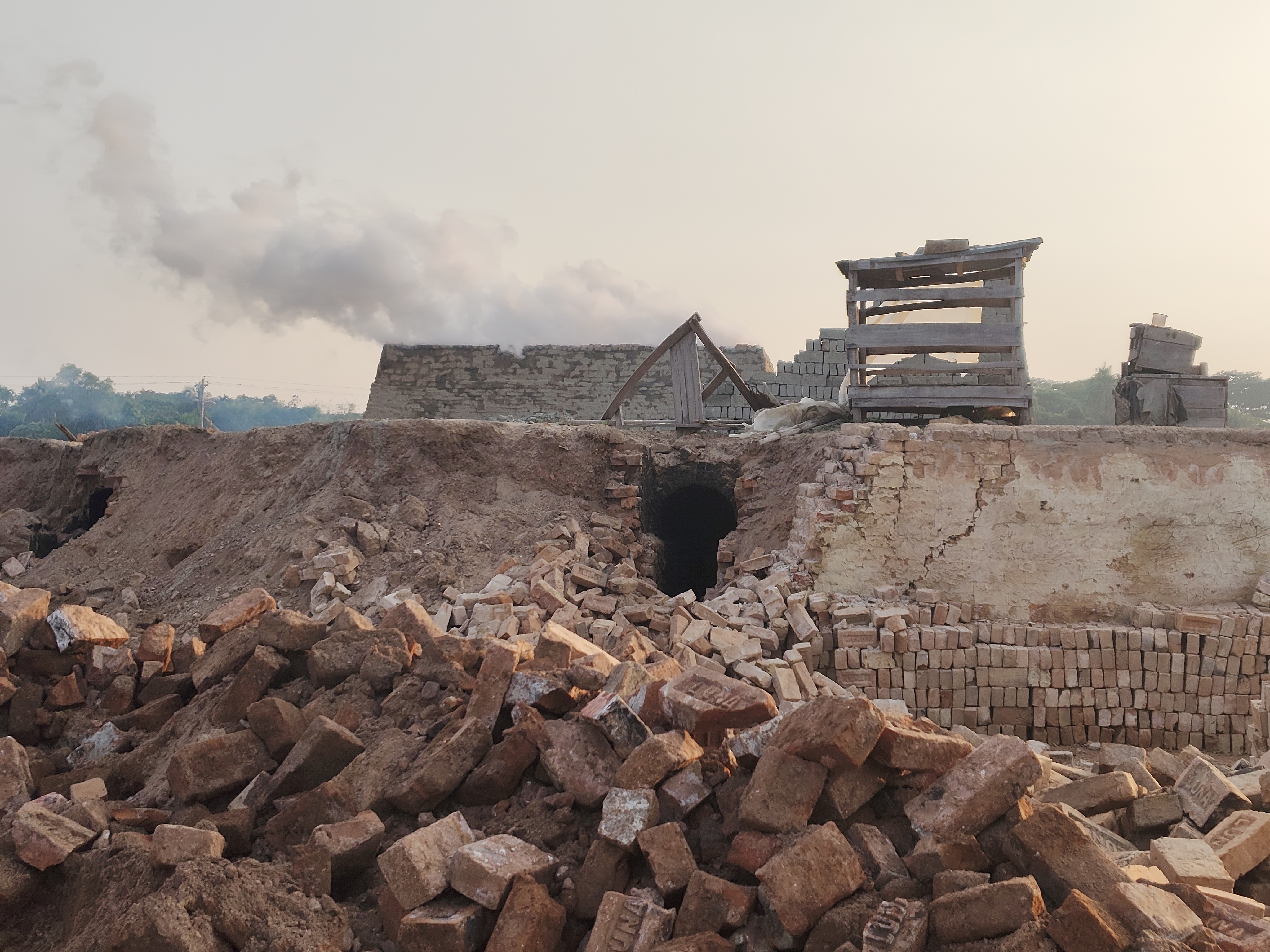
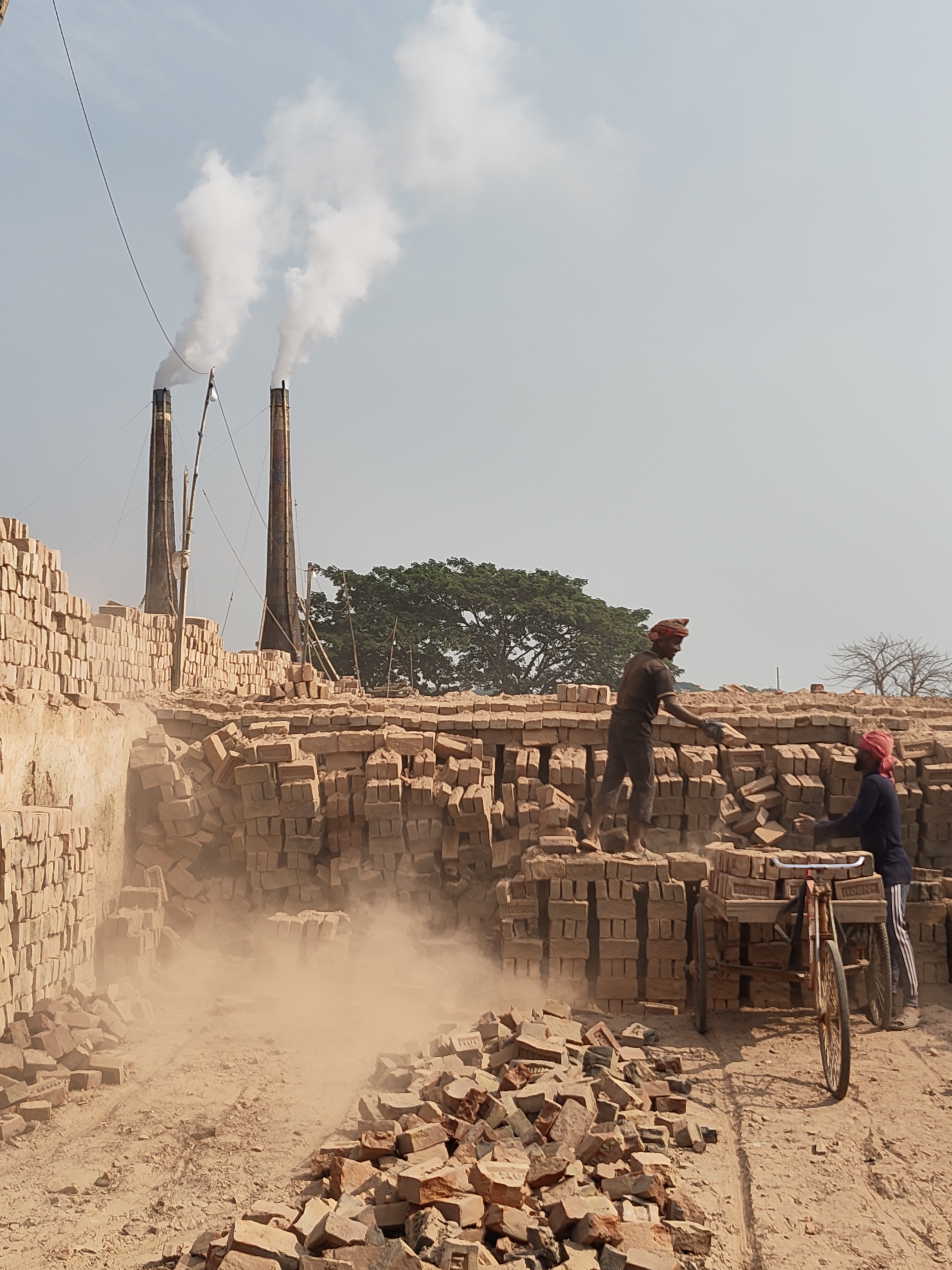
The labour structure and production of modern brickmaking in South Asia dates to the mid-nineteenth century when European brickmaking practices were imported to address the growing need from the British colonial state to build infrastructure for resource extraction and military control, notably for railway and cantonment construction. While new technologies have been adopted elsewhere to address rising wages and issues such as pollution, the continuing cheapness and availability of labour in South Asia means brickmaking in much of the region continues to be done using older, more labour-intensive methods (Lucassen 2006, Kerr 1995, and John 2018). To understand these dynamics, it is important not just to look at the sites of brick production, but also the places from where much of this labour emanates. One such site is Kalipara, a coastal village in Satkhira, where I conduct my fieldwork.
In the late afternoons in Kalipara, Shafique can often be found sitting on a concrete bench next to the small road that runs through the village from the main road to the embankment. He sits here in the summer months with friends to take advantage of the cool breeze that gently blows over the shrimp farms opposite. Shafique, in his 70s now, worked for most of his life as a seasonal labour migrant, just as his father and grandfather had before him and many other people in the village. He explains that migration is tied to the seasons. When he was younger people would stay in the village for the rice season before venturing out in search for work for short periods of time, a pattern of life he believed to have started in the time of the British. He told me that brickfield work first began in Kalipara in the 1960s, when one person had ventured out and begun bringing people to the brickfields, however it was in the early 2000s when it became a major livelihood, coinciding with the introduction of shrimp aquaculture. Our conversation was cut off by the sound of the adhan, the Islamic call to prayer, drifting over the shrimp farms, and he quietly excused himself to pray. Shafique’s story of migration is not unique, and shows how migration is deeply entwined with agriculture, through both its seasonality and the constantly changing landscapes of labour.
Seasonal migrations, however, are often thought of as a stable and old feature of life in Bangladesh. Often in conversations with NGO staff seasonal migration is described as a fixed, unchanging practice. Over lunch in a national NGO’s field office, I asked a young staff member when migration to the brickfields had begun in the area. He replied that this was the wrong question as, “it has always been this way”. When I asked how he knew, he explained that he had seen people migrating in this way since his own childhood. This sentiment is not uncommon and underscores why this type of migration rarely attracts the attention in the face of seemingly less predictable or more volatile forms of migration, such as those categorised as climate migration. A researcher at a thinktank in Dhaka asked why I was interested in seasonal labour migration which has always happened, and encouraged me to think more about climatic displacement, which he defined as people who have lost land to waterlogging, salination, or erosion. This naturalisation of seasonal labour migration as an inherent and inevitable feature of agrarian and urban life risks simplifying the dynamic context from which it emerges. The introduction of new, less polluting, and labour-saving kilns threatens to displace a large part of the workforce, yet there is little attempt to understand the complex role of brick work in their lives.
Shafique, like many others in the village, connects the seasonality of agriculture to the seasonality of labour. Agriculture’s seasonality is particularly acute when large plots of land are used for cash crops, as pointed out by Ali (2018) in relation to early-twentieth century jute, and more recently the introduction of shrimp across the coastal region. The change to cash crops and industrial farming displace more locally consumed crops and introduce global market fluctuations to local economies, thus changing the agrarian political economy, including by forcing people to go in search of work on unfavourable terms. The introduction of shrimp farming to places like Kalipara in the 1990s and 2000s often led to dispossessions of small landowners and displacements of landless people who in turn were unable to find work locally due to the low labour needs of shrimp farming (Paprocki 2021, Dewan 2021). The continued restructuring of agrarian landscapes then provides a ready supply of cheap labour for industries such as brickmaking, ensuring the continued profitability of labour-intensive, polluting brick manufacturing.
The seasonality of pollution in Dhaka creates a form of extreme weather: the pollution season. But to situate this pollution, as many technical government and multi-lateral development projects do, only within the industrial context of brick kilns, rather than the political economy of agriculture in which the brick kilns also function, misunderstands the problem and obscures the implications of technical solutions and regulations. The reduction of pollution in Dhaka would rightly be celebrated as a breath of fresh air, while in the village of Kalipara it is likely to remove seasonal livelihood opportunities that put food on the table as people attempt to weather rounds of agrarian restructuring that shape the seasonality of their lives. So, while an editorial of the Dhaka Tribune wrote in 2024, “The red brick… is fundamentally incompatible with the very idea of a healthy life, not to mention the future”, the story is very different in a village where many rely on these red bricks for the healthiest life possible in the circumstances (Dhaka Tribune, 2024).
Sitting on the side of the embankment in Kalipara, I asked Farhan, a labour broker for brickfields, what he thought about the Rizwana Hasan’s commitment to stop fired bricks and brickfields in 2025 and cease government purchases of bricks — the government being the largest consumer of these bricks. He looked tired as he responded it would be difficult for him and the people who work for him. He is worried about it because if it happens, he doesn’t know what he will do, he is too old to go outside for work. After a second to think, he added, “if they try to stop it there will be protests, and I will go because I have nothing in my hand”. Some might consider a labour broker as an unreliable interlocutor. Yet some of the labourers he contracted each year, sat around us playing cards, seemingly comfortable in the presence of someone from their village whose livelihood, like theirs, is deeply tied to the seasonal world of bricks.
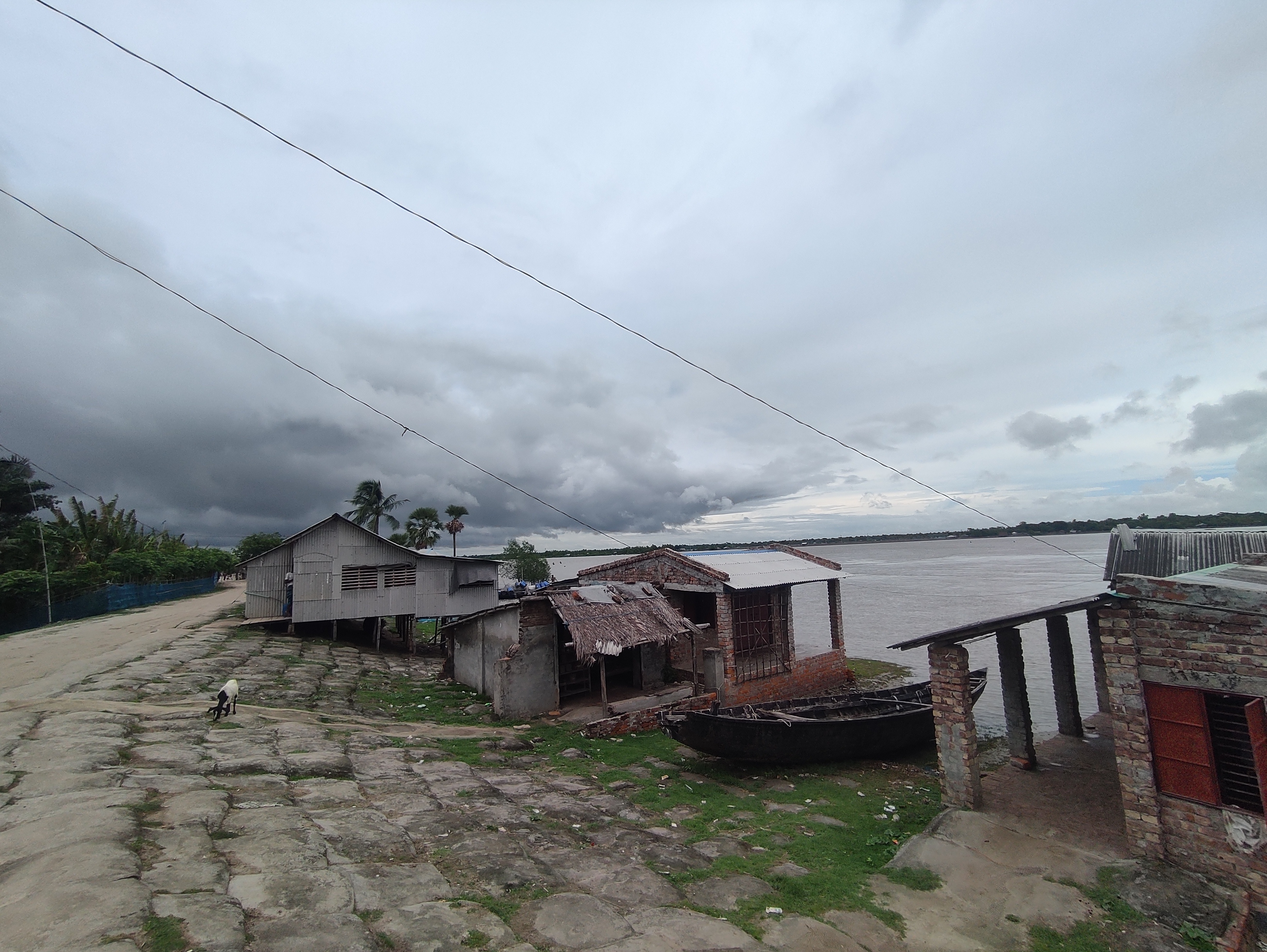
While brickfield migration is often seen as stable compared to climate migration, attempts to mitigate urban pollution are destabilising the migration threatening to become another rural problem for people who experience seasonality and weather acutely in their day to day lives. Seasonal pollution is a form of extreme weather that is mediated through different social structures running through agrarian villages, the labour that leaves these villages, and old processes of manufacture that are highly dependent on appropriate weather. Looking at the dynamics of labour in green transitions complicates the technical focus, forcing a broader and more holistic understanding of how processes of pollution come about, are maintained and who loses when they are stopped. Attempts to address urban pollution morph into new problems without serious engagement with the lives of the labourers and intertwined regional political economies of agriculture and industrial change.
References
Ali, T., 2018, A Local History of Global Capital: Jute and Peasant Life in the Bengal Delta, Princeton, NJ: Princeton University Press.
Dewan, C., 2021, Misreading the Bengal Delta: Climate Change Development and Livelihoods in Coastal Bangladesh, Seattle, WA: University of Washington Press.
Dhaka Tribune, 2024, Building the future: It is high time that Bangladesh made the switch, Dhaka Tribune, Available from: https://www.dhakatribune.com/opinion/editorial/365371/building-the-future (Accessed 15/09/2025).
John, J., 2018, Archaic Technology, Social Relations and Innovations in Brick Kilns, New Delhi, IN: Centre for Education and Communication.
Kerr, I., 1995, Building the Railways of the Raj, 1850-1900, Oxford, UK: Oxford University Press.
Lucassen, J., 2006, The Brickmakers’ Strikes on the Ganges Canal in 1848-1849, International Review of Social History, 1(14), pp.47-83. DOI: 10.1017/S0020859006002616.
Paprocki, K., 2021, Threatening Dystopias: The Global Politics of Climate Change Adaptation in Bangladesh, Ithaca, NY: Cornell University Press.