
Infrastructural Anxieties of Slum Redevelopment
Slum redevelopment is a core strategy within urban governance and state development policy in contemporary India. Since the early 2000s, the central government has launched consecutive rounds of policies and schemes aimed at improving urban infrastructures and achieving aesthetic goals in producing modern ‘world-class’ cities. Significant here are the Ministry of Housing and Urban Poverty Alleviation’s initiative, the Rajiv Awas Yojana (2011-2014), which explicitly articulated the goal of creating a “slum-free India” through slum rehabilitation projects and the Pradhan Mantri Awas Yojana (Urban) Mission (PMAY-U) (2015-2022), which set an ambitious target of providing affordable and adequate ‘housing for all’ (Mahadevia et al., 2018; Vaid, 2021). Under these initiatives, states and cities alike have been tasked with the role of developing their own policies and projects for redeveloping informal settlements and for resettling eligible residents. However, low-income housing ‘rehabilitation’ projects are also discursively framed as being important pathways through which urban environmental priorities are produced (i.e. the ‘clean and green city’) and as measures for fostering urban climate resilience.
In the city of Ahmedabad, the sixth largest city in India and the largest in the northwestern state of Gujarat, the informal settlement Ramapir no Tekro is currently being redeveloped under an in-situ model, where eligible residents have been promised flats in the emerging new seven-story towers being built in place of their former homes. Many residents seem to cautiously hope that the promises this ‘slum rehabilitation’ project makes will actually materialize for them. Not only that they will retain their same location and proximity to essential livelihood spaces, but also because of the infrastructural promises that the ‘modern’ towers provide toward easing the many environmental vulnerabilities residents of this settlement struggle with.
I have written elsewhere about the structural and embodied challenges women working as waste pickers in Ahmedabad experience through their work and home environments (Wittmer, 2021; 2023a, 2023b); however, emerging and urgent climate challenges are now compounding earlier experiences. For example, in recent years, residents of this settlement report their struggles with having to navigate increasing and more intense heatwaves in the summer as well as higher seasonal flood levels and temporary displacements during the monsoon (also see Marnane & Greenop, 2023 and AMC & ICLEI South Asia, 2023). These climate impacts are situated alongside year-round infrastructural vulnerabilities associated with inconsistent water, sanitation, and electricity supplies. Figure 1, taken in January 2018, shows a major artery through the community in the southern section of the settlement after a rare winter rain. In the monsoon, some houses and roadways in the settlement are completely waterlogged, with those closest to the creek and floodplain being more than 2 meters below water. Kali Marnane and Kelly Greenop (2023) very thoroughly documented the local floodplain and housing in their piece about a section of this settlement.
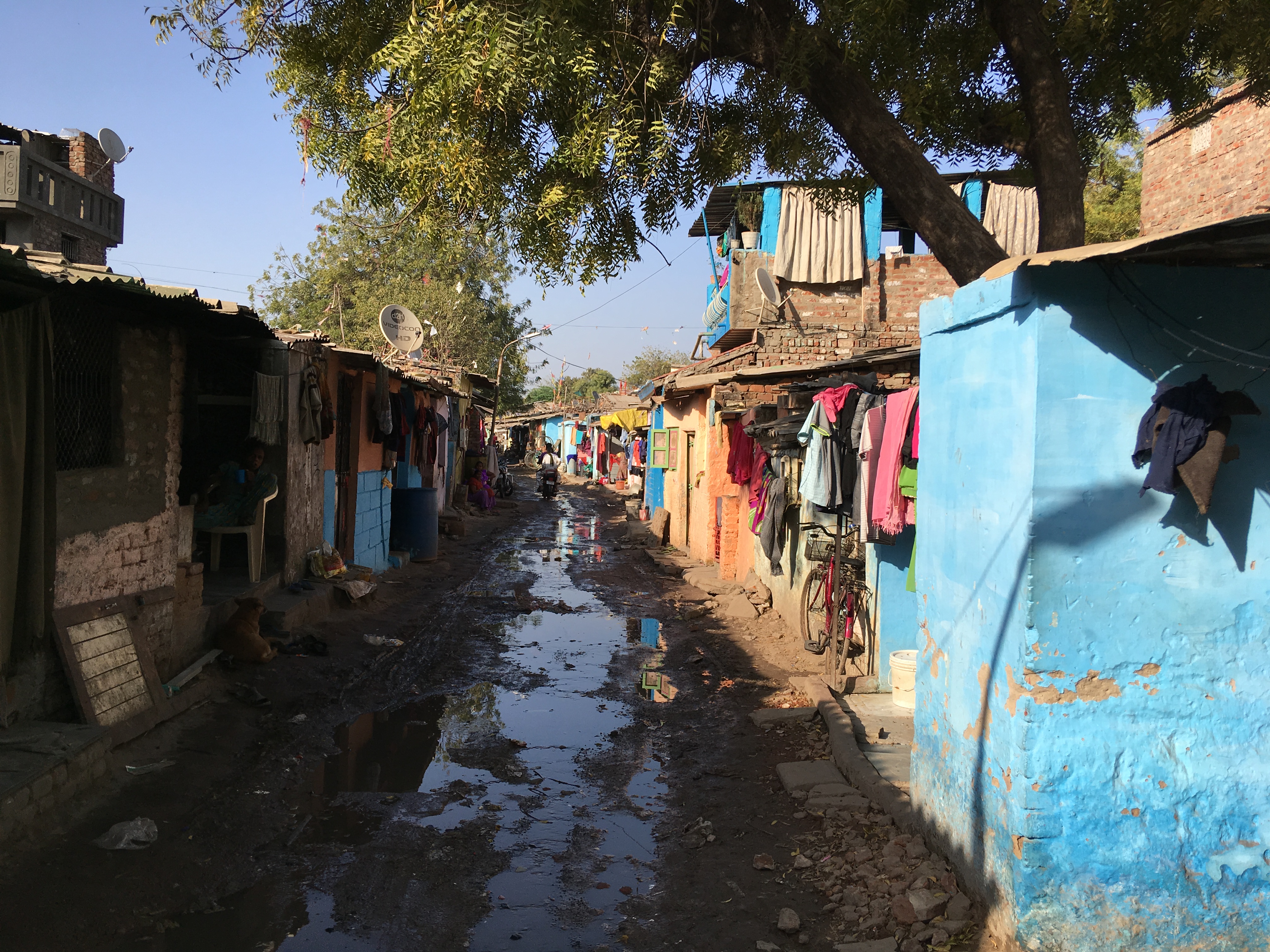

The redevelopment project is articulated by the state as improving housing conditions and services for the urban poor and is indeed welcomed by some. However, there are also many expressed concerns about the tenability of informal livelihoods in the verticalized future of this settlement, of previous broken promises by the state, and of the knowledge of developer profits and unequal financial and political benefits manifesting through the project. These concerns were especially strong for the thousands of residents from this settlement who earn daily incomes as waste pickers and scrap buyers in the city and rely on the accessibility of open communal spaces for segregating, storing, and selling materials in the community, spaces that will no longer exist in a vertical future. Siddarth Menon’s (2023) work on housing transformation (from mud to concrete) in Himachal Pradesh similarly urges an intersectional analysis of such changes in the built environment, as Dalit women in low-income and caste-ascribed forms of labour tend to experience the brunt of the impacts of infrastructural developments that aren’t designed with their environmental priorities in mind.
Alongside my observations of the city’s waste management and labour practices between 2016-2024, I have documented the material transformation of the Ramapir no Tekro settlement from the perspectives of women community members. By visiting and speaking with these interlocuters at their homes, shadowing their daily work routines, and spending time at the local recycling social enterprise, Paryavaran Mitra, I have been privy to ongoing local discussions and debates about the re-development of the area – from the time rumours of redevelopment surfaced in 2017 through the rolling evictions starting in 2019, to the total demolition of (almost) all homes in the settlement and a state of in-betweenness and fracturing, as documented in 2024.
As this in-situ project extends over time and space, I trace how the promises, uncertainties, and impacts of slum ‘rehabilitation’ evolve across multiple phases of this major reconfiguration of the urban environment and relations therein. In this case study, I am thinking through the unsettled nature of in-situ redevelopment by reflecting on the shifting embodied strategies, improvisations, and emotions that unfold across the liminal spaces between the ideation, demolition, construction and realization of a project. Residents' experiences point to their nuanced perceptions of the project as they simultaneously hold hope about the its promises of improving living conditions in a changing climate in tension with the anxieties of producing daily incomes amidst their temporary displacement from place and their mistrust in the state to materialize its promises due to previous betrayals by such paperwork and actors.
Ramapir no Tekro and its residents as urban environmental infrastructures
Over the last decade, my work on waste management and recycling labour in Ahmedabad has continually brought me into Gujarat’s largest informal settlement, Ramapir no Tekro, on the western bank of the Sabarmati River. While I was speaking with women engaged in self-employed waste picking labour around the city, many women I met working in commercial and residential areas on the west side of the kept mentioning their homes in ‘the Tekro’ and I was eventually invited back to several homes to visit and continue chatting. I also started volunteering with the NGO scrap shop inside the settlement, Paryavaran Mitra (friends of the environment) through my PhD dissertation research from 2016-2018. The settlement is situated on public land owned by the Ahmedabad Municipal Corporation (AMC) and was established 50-60 years ago by labourers who migrated to Ahmedabad from rural areas of Gujarat and Rajasthan. At 75 acres before redevelopment began, the settlement was comprised of 8500 dwellings and had an estimated population of 150,000 people (CEPT University, 2014; Marnane & Greenop, 2023).
Ramapir no Tekro was largely inhabited by Scheduled Caste Hindu families, with many people working in caste-ascribed labour in the informal waste economy. The space and its residents provided a major infrastructural and economic service to the city as thousands of women residents work as self-employed waste pickers (or ‘informal recyclers’) and serving as the site for at least 18 scrap shops which collectively serve as a major node in the city’s informal waste economy, selling thousands of tons of scrap into the formal recycling industry each year. As a whole, the settlement represents a space and workforce that provided low-cost environmental services to the city and largely remained invisible the settlement occasionally came into the public eye and was problematized as an eyesore, a source of disease, or in need of covering up from view as foreign dignitaries visited to the city for global meetings and climate summits (see Gill, 2010 and Gidwani & Maringanti, 2016 for similar dynamics around urban waste nodes in other cities).
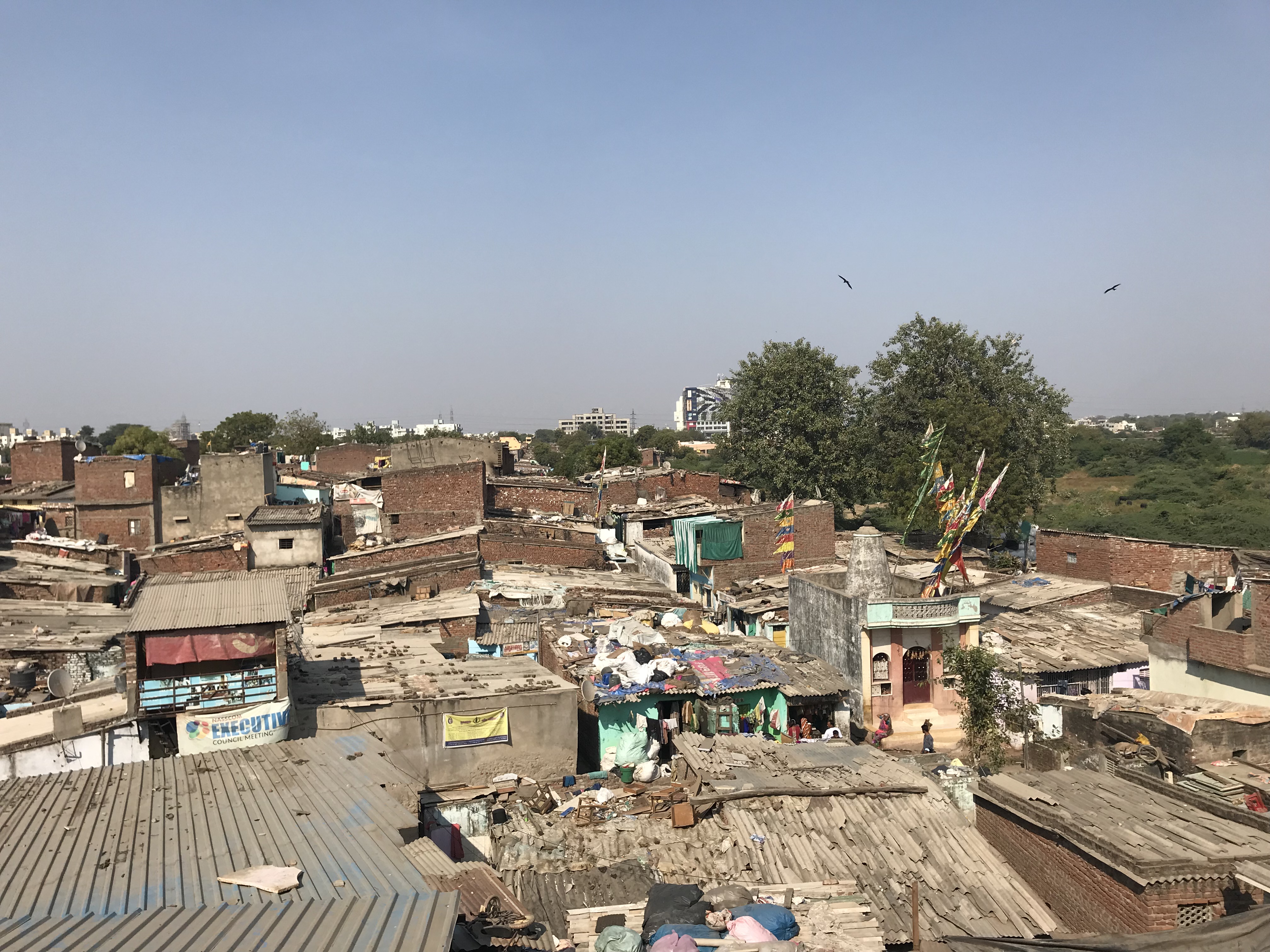
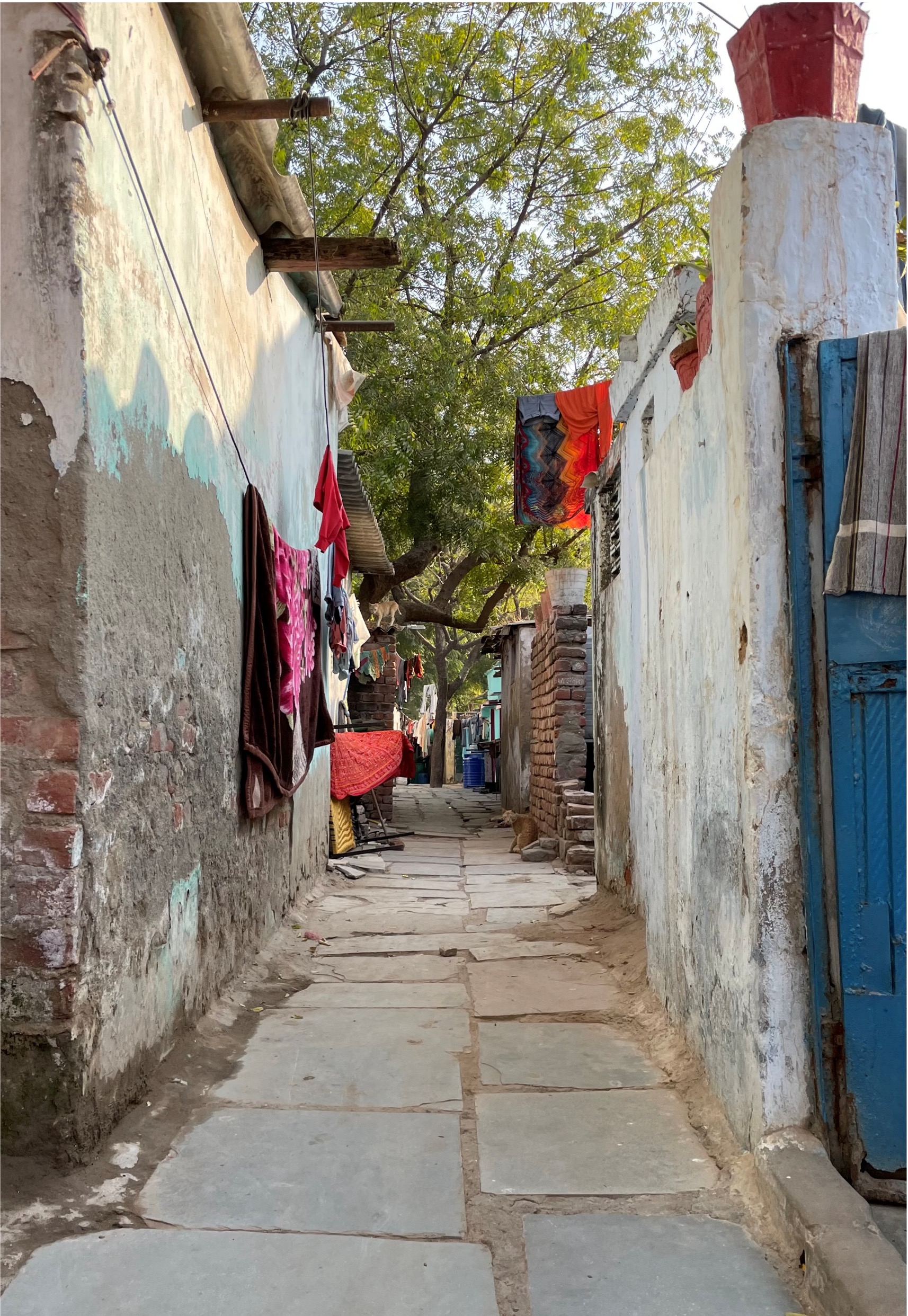
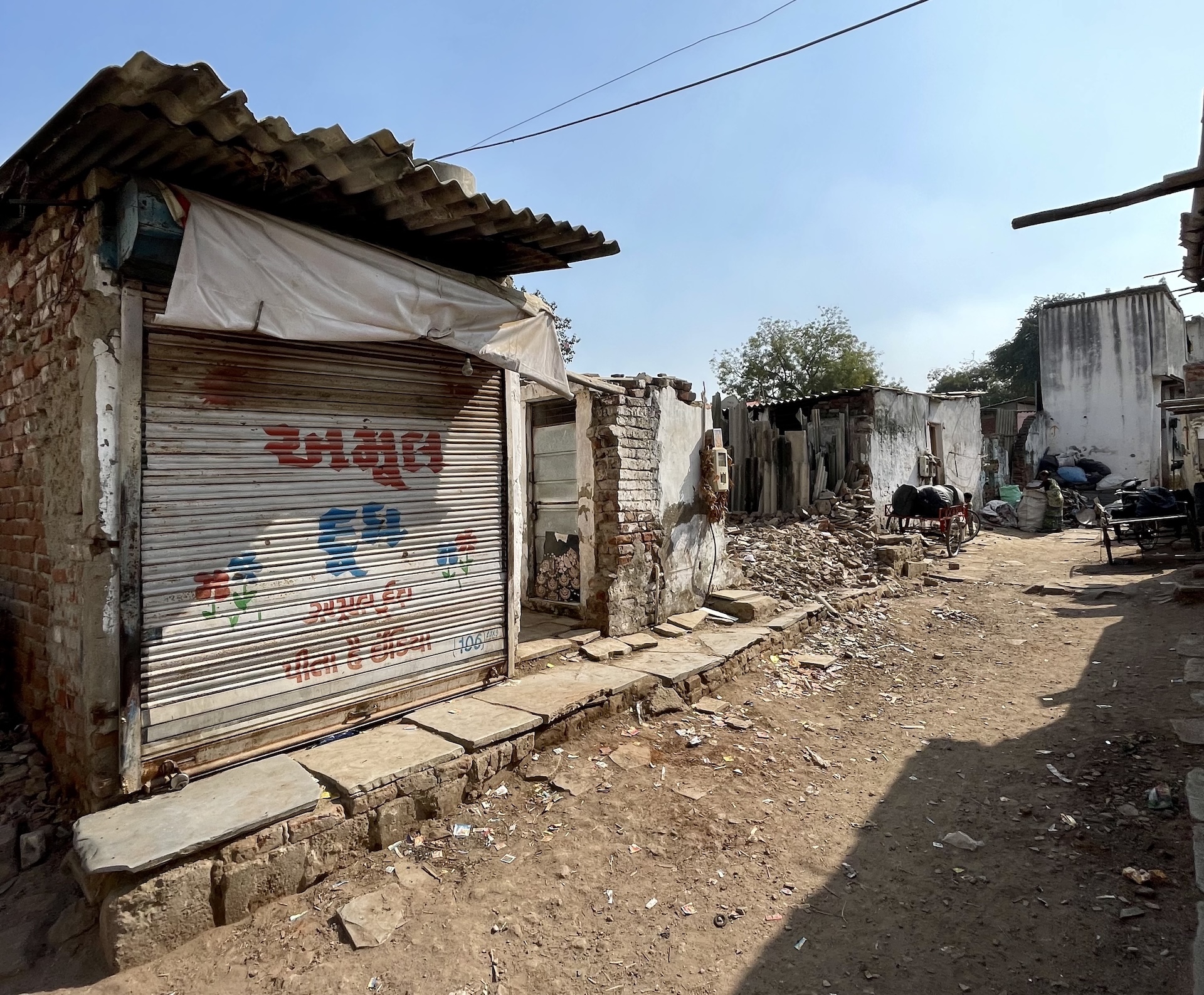
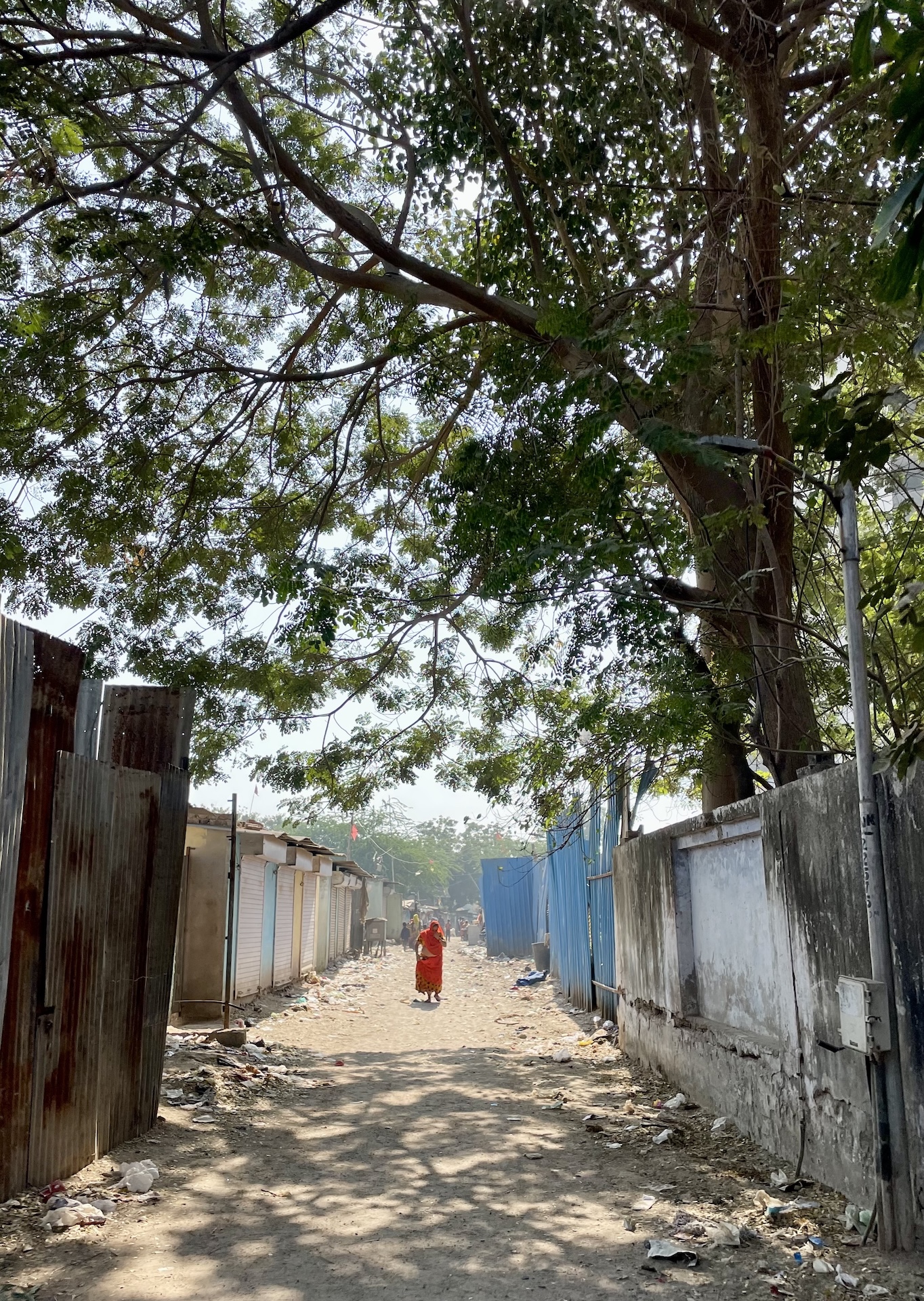
The houses in Ramapir no Tekro were predominantly of pucca and semi-pucca construction (of baked/permanent or semi-baked/permanent), with kutcha (raw or impermanent) houses dotting the outskirts of the settlement along a creek that drains into the Sabarmati River and some small farms. The government installed a sewer line into the settlement after which residents could pay to install water and sanitation infrastructures to their own dwellings, or as was more commonly the case, in collective semi-private spaces shared with kinship and family groups (see Marnane & O’Rourke, 2024 for detailed descriptions of dwelling types and building traditions in the settlement). No matter the location of one’s water supply, whether private, semi-private, or public, water supply to the community was inconsistent, with water coming to the tap for a few hours a could times a day. Figures 2 and 3 are streetscapes taken in March 2017 and February 2018 that show what the settlement and its houses looked like before the redevelopment project began:
In-situ slum redevelopment
As a notified slum, Ramapir no Tekro was listed for “In-Situ Redevelopment on Public Land (Slums on Public Land)” under the Gujarat Slum Rehabilitation and Redevelopment Policy (Gujarat State Government, 2013; CEPT University, 2014). The in-situ approach is considered a relatively new ‘best practice’ approach to slum upgrading (e.g. UN-Habitat, 2016) and as preferable to earlier approaches to land and project development, which involved the resettlement of communities lacking formal tenure on desired parcels of land to distant resettlement sites.
In Ahmedabad, recent instances of displacement-based resettlement programs for evicted slum dwellers have been significantly criticized in major projects like the Sabarmati Riverfront Redevelopment, the Kankaria Lake Redevelopment, and the construction of the BRTS transit arteries and infrastructures. Across these projects, scholars and advocates documented non-transparent and inequitable resettlement eligibility criteria and processes, sub-par or non-functioning infrastructures at resettlement sites, loss of livelihoods due to distance outside of the city, and a sense of betrayal residents felt by broken promises pervaded the projects (Desai, 2012, 2018; Desai et al., 2018; Mahadevia et al., 2017; Salmi, 2019; Vaid, 2021). The in-situ slum rehabilitation at Ramapir no Tekro is slated to build 8,000 2-bedroom houses in blocks of 7-story towers for eligible slum dwellers with the stated aim to “minimize the problems created through unhygienic and poor outreach of basic infrastructure facilities in the slums” (Smart City Ahmedabad, 2023). The construction is being undertaken in a fragmented approach with the settlement divided into 6 sectors. Each of the 6 sectors is being developed by a different company who is charged through a Public-Private Partnership with design and construction, but also in the communications with residents and the processes of determining eligibility for a flat per the 2013 Gujarat Slum Rehabilitation and Redevelopment Policy.
Infrastructural anxieties and transformations over time
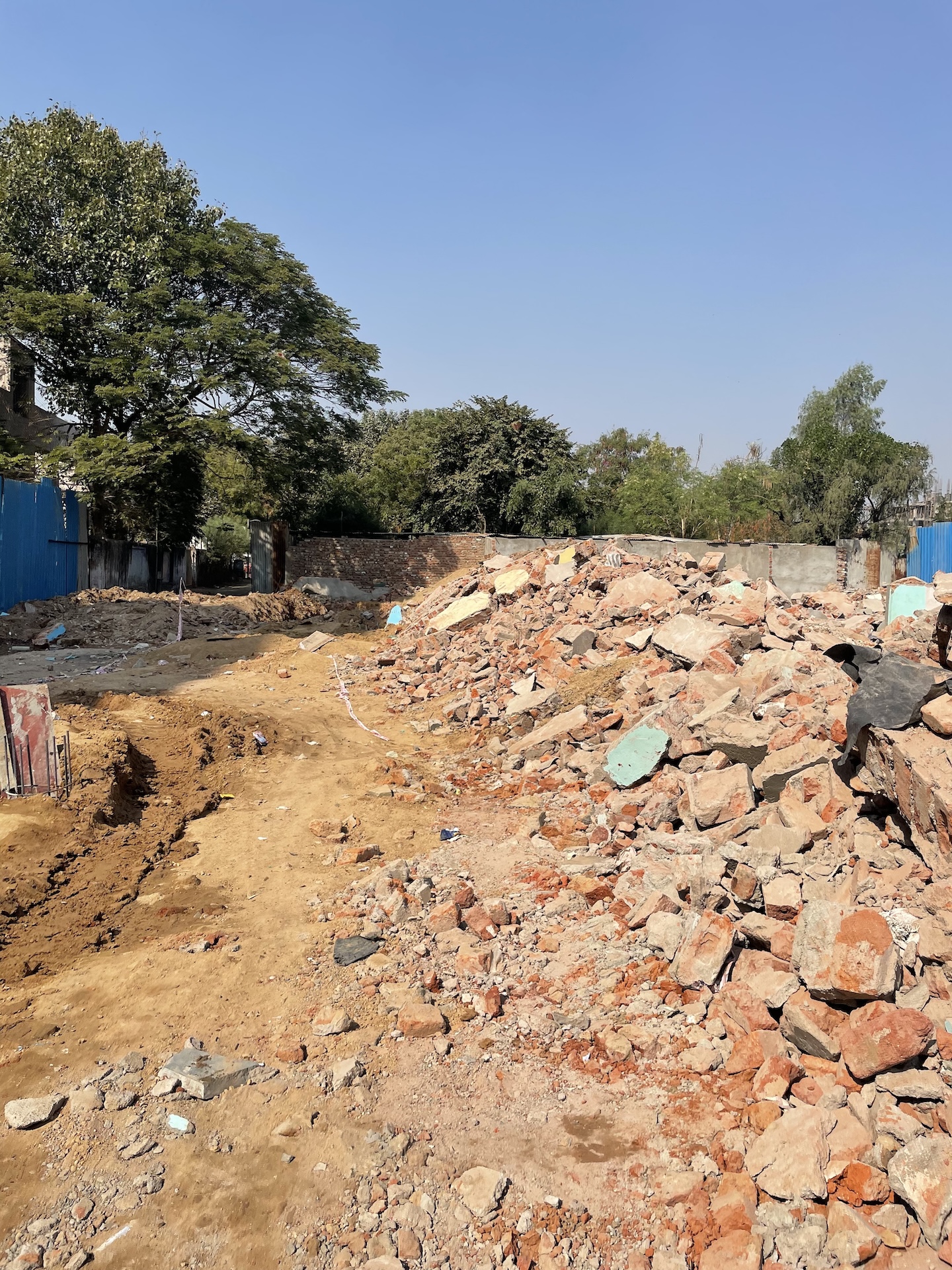
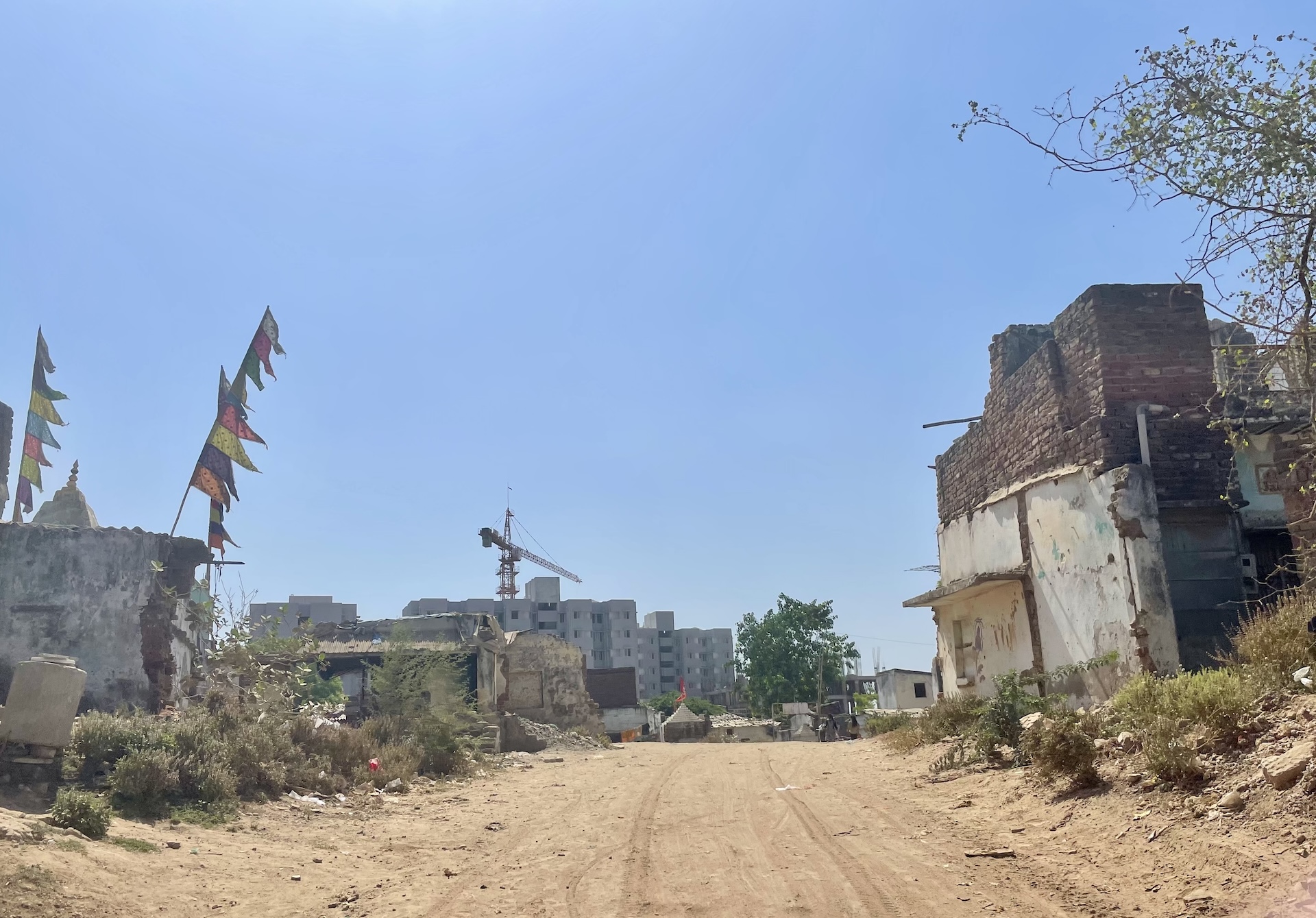
Starting in 2019 and working section by section, residents started receiving notice to provide their documentation and begin the process of leaving their homes. Residents meeting eligibility requirements and who could provide the required documents to the developers received portfolios detailing their documents and the written promise of a new flat in the towers. They also receive ₹ 7000/month from the developers to find ‘transit accommodations’ as they await their new flats. The staggering and overlapping of the demolition and construction phases of the project across the six sectors produced a visible fracturing of local physical infrastructures, where some blocks were entirely demolished (figure 4 – January 2023) while others were still standing and functioning as usual. In other neighbourhoods, some homes had been demolished into a pile of rubble while others remained standing and in-use (figure 5 – December 2022).
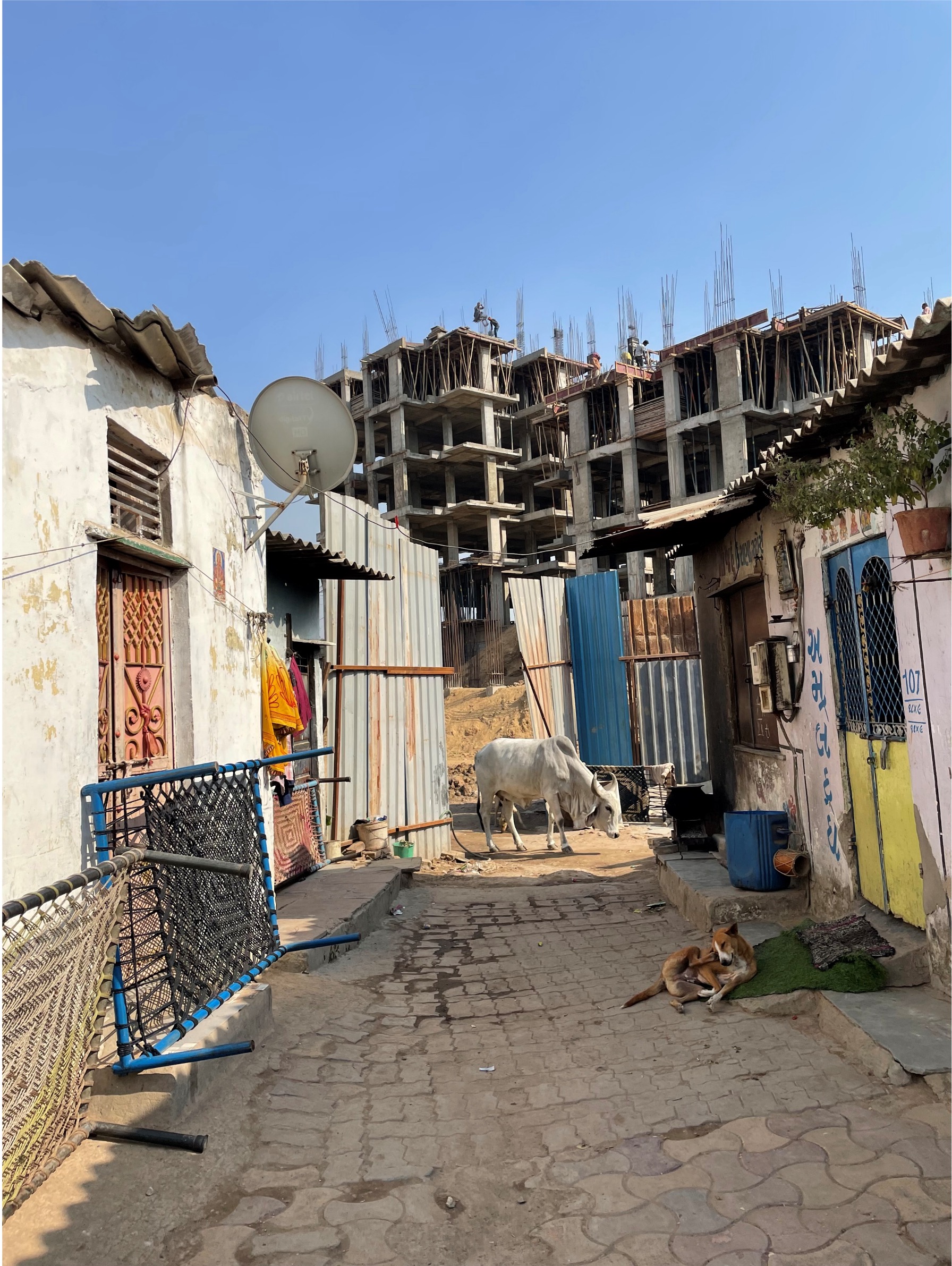
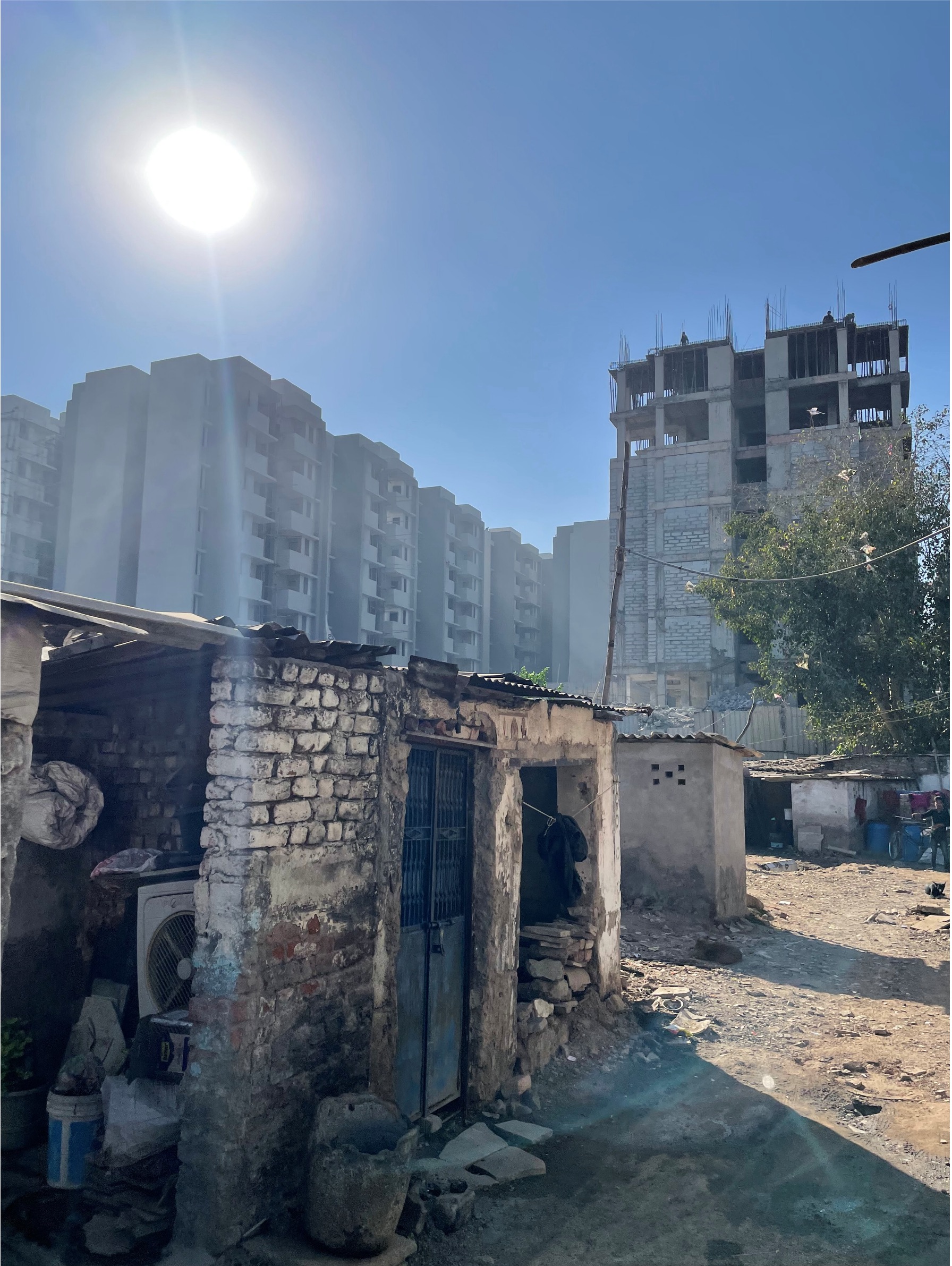
In 2022 and 2023, this state of material in-betweenness produced anxiety and a sense of inevitability in terms of the eventual destruction of women’s homes. This expression of unease was especially strong for those who had not yet been approached by developers, those who were unaware of the intended timeline for evacuating their block or home, and those (such as older widows) whose neighbours gone to live with family members elsewhere, but who themselves had nobody to lean on or a place to go. In Figures 6 & 7 (both from December 2022) and Figure 8 (January 2023), redevelopment appears as a partial state of demolition and construction mixed with everyday life: unfinished modern towers rising out of rows of remaining houses and shops and among demolition debris, construction equipment, and barricades blocking off old footpaths.
This physical state of in-betweenness produced uncertainty and worry among women recyclers in terms of their livelihoods and ability to support themselves with daily wages, especially in the immediate interim period of construction while they waited for their new flats. For Dalit women in Ahmedabad, informal recycling work is based on important social infrastructures and geographies of proximity as women from the same place will travel to and from their work areas and homes before sunrise together, share space and time in sorting and storing their recyclables, and in having their scrap dealer/shop nearby to sell materials (Wittmer, 2021, 2023a). Amidst rumours of redevelopment, women recyclers quickly expressed fear that they would not be able to continue their work as usual if they had to move too far away or if their scrap shops inside the settlement closed. In 2022-23, when the redevelopment was underway and some households had left, the remaining I spoke to said that they feared that they would be evicted next and were fearful about potential difficulties in finding a new place to live and their ability to continue working.
In my visit in 2024, the settlement was almost fully demolished (see Figure 9, May 2024). I found that all of the women recyclers from my study who were from Ramapir no Tekro were continuing to do waste picking work, but that with only Rs.7000/month from the developer, the only flats they could afford were in the periphery of the city, an average of 5km away from their former homes and their continuing recycling collection areas. The location of the temporary ‘transit accommodations’ and these new living situations were not without their challenges, including (but not limited to) having to spend more time and money on transportation to/from work areas and in transporting recyclables to relocated scrap shops, also located further afield than the formerly central location. Women also spoke of social-cultural tensions at their temporary rental accommodations and the need to hide their work for fear of shame from new neighbours from other communities who would not like to be associated with waste labour or labourers. Finally, a significant anxiety women expressed was about the uncertainty of the timeline for when they could move into their new flats and return to the more central location, walking distance from their work areas.
Uncertain futures: “We will only know when it happens”
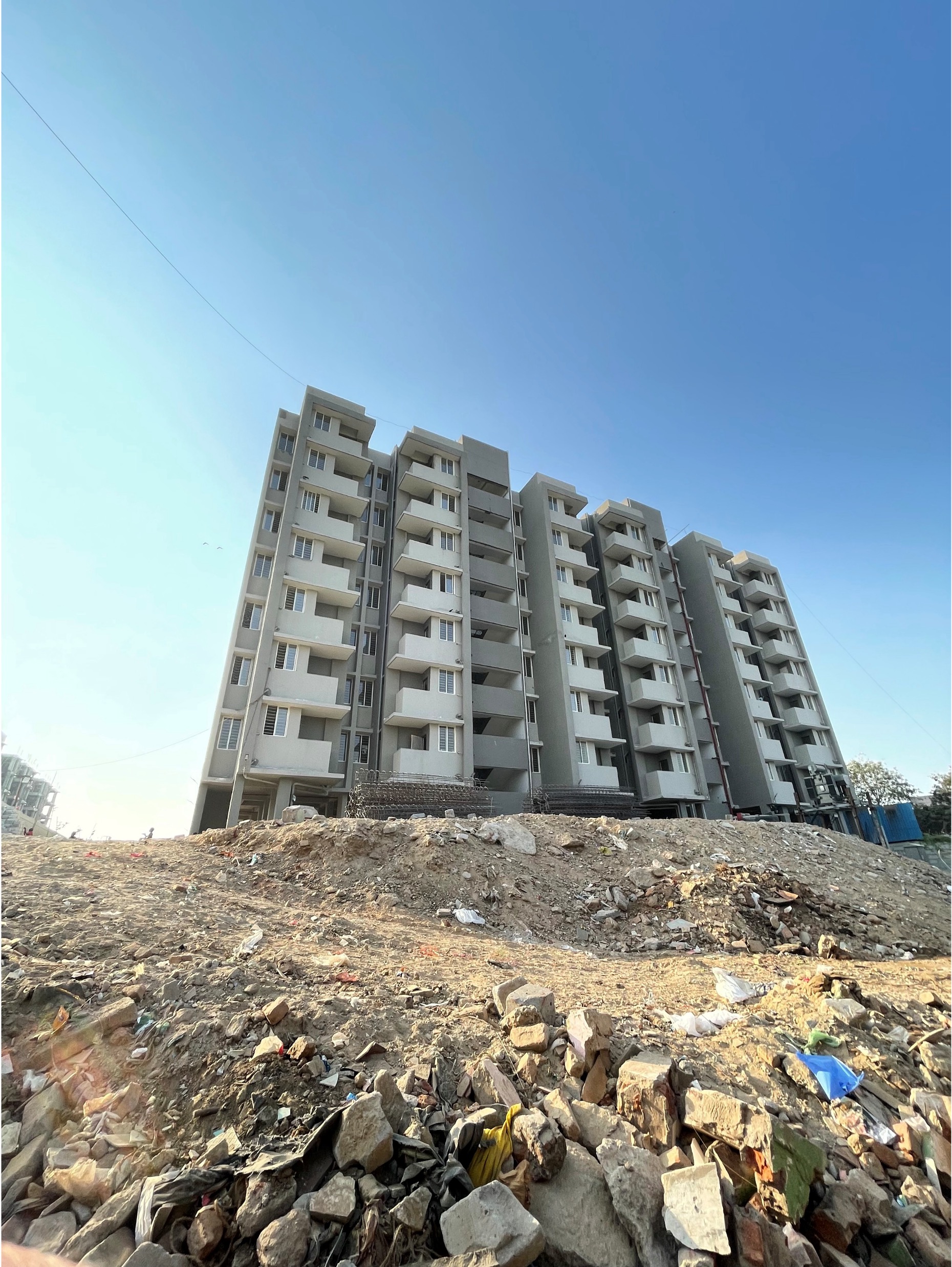
When I broadly asked women recyclers what they think about the project, a common refrain that emerged was, “we will only know when it happens.” Many were hopeful that the flats they were promised will actually materialize but remain skeptical about whether or not it will happen. In 2024, after all my interlocuters and their neighbours had moved from the settlement and received their confirmation of eligibility documents, they were quicker to express their hopes about a future where they have a home that won’t flood in the monsoon and with solid walls and windows which will prevent disease-carrying mosquitoes from entering and making family members sick. They were also hopeful for a future with reliable infrastructural services including 2/4 electricity (and therefore lights, fans, refrigeration, and television), 24/7 piped water, and a gas line would ease the burdens of their everyday reproductive labour. A couple of women also articulated a hope that a new and more ‘modern’ way of living might prompt behavioural changes among their husbands, sons, and male community members in terms of their issues with alcohol and abuse. Secure access to income, basic services, tenure, and education opportunities for children are the desires of an infrastructural future that meets the environmental needs of the poor and improves health and wellbeing. However, this vision of the future is yet to be unveiled, and community members remain uncertain about whether promised made by the state and developers will come to fruition. Figure 10 is a photo of one of the first towers constructed in section 1 rising out of rubble in February 2023.
The uncertainties residents associate with this in-situ slum redevelopment project speak to the ways in which infrastructural development can invoke a range of affective and material experiences about potential futures in the months and years that transpire across the phases of a massive reconfiguration of urban space, infrastructure, and fabric. These experiences have led me to think about how redevelopment unfolds over time with various impacts for vulnerable daily wage-earning residents experiencing disruptions and unsettlement to their urban environments and access to resources at different phases and through the “extended pauses” that comprise a project (Weszkalnys, 2017: 8). Finally, this study highlights the evolving nature of residents’ material and affective responses and strategies that they adopt to navigate uncertainty over time. In this context, infrastructure projects can “hold competing and often quite divergent hopes and expectations together” to produce simultaneous moments of promise and failure (Harvey & Knox, 2012: 522).
Ahmedabad has now articulated its future as a “sustainable city that prioritises the well-being of Ahmedabad’s residents and preserves natural ecosystems” in its Ahmedabad Climate Resilient City Action Plan (AMC &ICLEI South Asia, 2023: iv). The action plan details priorities for tackling climate threats like urban heat, flooding, poor air quality, and resource challenges with sustainable infrastructure solutions. This vision notes that a “robust climate-resilient” urban future will also necessarily integrate improvements to gender and equity issues alongside those of sustainable infrastructures. For the in-situ redevelopment of the Ramapir no Tekro settlement to produce this infrastructure-led, climate resilient, and socially equitable future, the urban environment needs to be continually considered in diverse ways with an ethic that privileges the urban environmental priorities of the thousands of Dalit women workers who live(d) this settlement and also desire a climate resilient future in which access to basic services, livelihood opportunities, and safety are of the utmost importance.
References
Ahmedabad Municipal Corporation (AMC) and ICLEI South Asia (2023) Ahmedabad climate resilient city action plan: Toward a net zero future. Executive Summary, July.
CEPT University. (2014). Ahmedabad Slum Free City Action Plan. Accessed at: https://pas.org.in/Portal/document/PIP%20Application/Ahmedabad%20Slum%20Free%20City%20Action%20Plan%20RAY.pdf
Desai, Renu. (2012). Governing the urban poor: Riverfront development, slum resettlement and the politics of inclusion in Ahmedabad. Economic and Political Weekly, 47(2): 49-56.
Desai, R. (2018). Urban planning, water provisioning and infrastructural violence at public housing resettlement sites in Ahmedabad, India. Water Alternatives, 11(1), 86–105.
Desai, R., Sanghvi, S. & Abhilaasha, N. (2018). Mapping evictions and resettlement in Ahmedabad, 2000-2017. Centre for Urban Equity: Working Paper #39.
Gidwani, V., & Maringanti, A. (2016). The Waste-Value Dialectic: Lumpen urbanization in contemporary India. Comparative Studies of South Asia, Africa and the Middle East, 36(1), 112–133.
Gill, K. (2010). Of poverty and plastic: Scavenging and scrap trading entrepreneurs in India’s urban informal economy. Oxford University Press.
Government of Gujarat. (2013). Policy for in-situ rehabilitation of slums situated on public land by public-private partnership under Mukhya Mantri GRUH (Gujarat Rural Urban Housing) Yojana. Gandhinagar: Urban Development and Urban Housing Department. Accessed at: https://ahm.gujarat.gov.in/gujarat-slum-rehabilitation-policy-ppp-2010/
Harvey, Penny. & Knox, Hannah. (2012). The enchantments of infrastructure. Mobilities, 7(4), 521–536.
Mahadevia, D. & Desai, R. (2017). Vatwa resettlement sites: Constrained mobility and stressed livelihoods. Centre for Urban Equity: Ahmedabad Policy Brief 1. Accessed at: https://cept.ac.in/UserFiles/File/03%20CEPT%20University%202016/CUE/Policy%20Briefs/Ahmedabad%20Policy%20Briefs.pdf
Mahadevia, D., Bhatia, N. & Bhatt, B. (2018). Private sector in affordable housing? Case of slum rehabilitation scheme in Ahmedabad, India. Environment and Urbanization ASIA, 9(1): 1-17.
Marnane, K. & Greenop, K. (2023). Housing adequacy in an informal built environment: case studies from Ahmedabad. Journal of Housing and the Built Environment, 38: 2059-2082.
Marnane, K. & O’Rourke, T. (2024). Informal settlements and the continuity of Gujarati building traditions in Ahmedabad. The Journal of Architecture, 29(3): 406-432.
Menon, S. (2023). Class, caste, gender, and the materiality of cement houses in India. Antipode, 55(2): 574-598.
Salmi, J. (2019). From Third-Class to World-Class Citizens: Claiming Belonging, Countering Betrayal in the Margins of Ahmedabad. City and Society, 31(3), 392–412.
Smart City Ahmedabad. n.d. Area-Based Development Projects Portal. Accessed at: https://ahmedabadcity.gov.in/AcknowledgmentReceiptTemplet/smartcitymission.html#abdProjectsDiv
UN-Habitat. (2016). Slum almanac 2015-2016. Nairobi: UN-Habitat. Accessed at: https://unhabitat.org/slum-almanac-2015-2016-0
Vaid, U. (2021). Delivering the promise of ‘better homes’?: Assessing housing quality impacts of slum redevelopment in India. Cities, 116: 103253.
Weszkalnys, Gisa. (2017). Infrastructure as Gesture. In Harvey, P., Bruun Jensen, C. & Atsuro, M. (eds.) Infrastructures and Social Complexity: A Companion. CRESC. Routledge. Pp.284-295.
Wittmer, J. (2021). “We live and we do this work:” Women waste pickers’ experiences of wellbeing in Ahmedabad, India. World Development, Vol 140: 105253.
Wittmer, J. (2023a). Dirty work in the clean city: An embodied urban political ecology of women informal recyclers’ work in the ‘clean city’. Environment & Planning E: Nature & Space, 6(2): 1343-1365.
Wittmer, J. (2023b). “I salute them for their hard work and contribution”: Inclusive urbanism and organizing women recyclers in Ahmedabad, India. Urban Geography, 44(9): 1911-1930.