
Staging Encounters: Chronicles of Displacement at the River’s Edge
Design renders for the Ravi Riverfront Urban Development Proposal (RRUDP) showcase clear, deep blue water, tall buildings, and lush greenery surrounding the Ravi riverbank as it flows through the city of Lahore. A glimpse into the future, these images replace the river’s silt laden murky water and existing dwellings on its banks with a sanitized and idealized vision for a riverfront city. Centering economic growth as one of its driving manifestos, it allegedly caters to a population of ten million inhabitants and targets a 40-billion-dollar revenue generation through its first phase of development.1 This initiative of constructing “world’s largest” riverfront city promises to revive the Ravi River by confining it within 1-km wide concrete embankments. Missing from RRUDP’s renderings and masterplans, however, are the multiple communities who inhabit its banks, rely on the river for sustenance, as well as the river’s historic relationship to the city of Lahore and its citizens.2
In purporting to rebuild the link between the river and its environs (especially its local communities) through a concrete embankment, the state advances exclusive narratives catering to privileged societal groups and imperial agendas. The RRUDP thus extends longer histories of top-down hydraulic and social control in the Indus basin, starting in nineteenth century (Akhter, 2015; Gilmartin, 2015; Hayat, 2024; Wescoat, 2025). It questions the reductive nature of such proposals which sever existing ties of minoritized groups from riverine landscapes and result in their eventual displacement to make way for futuristic visions of development. As such, these visions simultaneously portend the ecological demise of the river through the materialization of post-colonial ambitions still operating on colonial design legacies. This inquiry draws on local perspectives to challenge the perception of the river’s edge as an unyielding line amidst the climate crisis and rapid urban development to illustrate fragmented imaginaries of the River Ravi, erased from the RRUDP vision.


Centering voices from marginalized riverine communities, specifically from the many community groups interviewed as part of my fieldwork in 2023, this drawing proposes an alternative approach for encountering the river’s edge. By emphasizing the need to center lived experiences in architectural discourse and representation, the drawing forges an attempt to resist capital-driven marginalization and displacement often executed through the erasure of these voices. The river’s edge, despite its desolate condition today, is much more than a singular line dividing land from water. It is an expansive, dynamic meeting point for multiple entanglements, local rituals and ecological movements. The panorama, historically recognized as a colonial device of staging the world, approaches the river as an integral component of the larger Punj-aab landscape.3 It subverts the hegemonic view captured in pre-existing colonial panoramic paintings of the river (Sinha and Ruggles, 2004).4 Instead, the drawing stages the Ravi as a cultural vessel for residents of both Lahore, Shahadara (across the river) and for those collectively bemoaning its impending loss.5
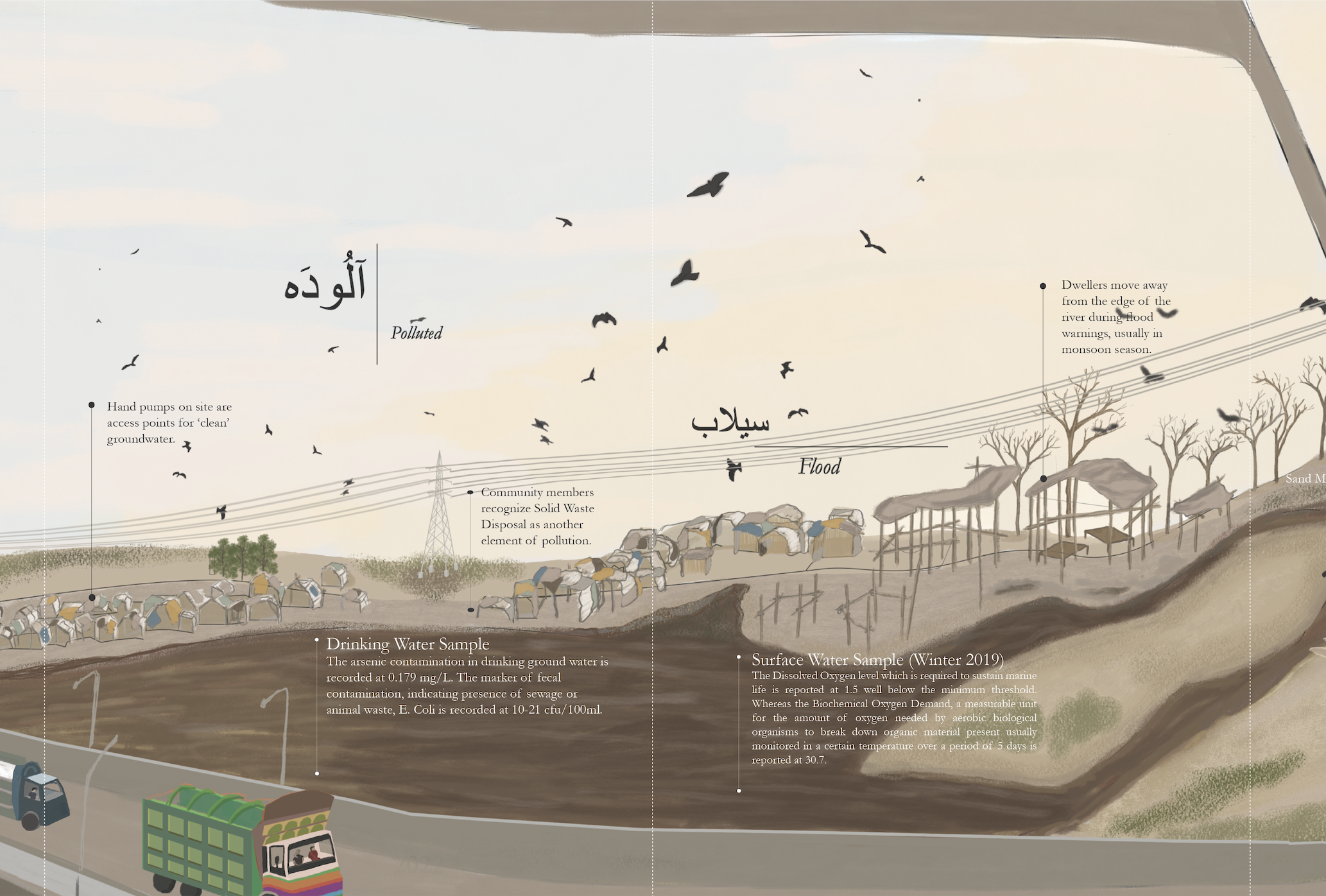
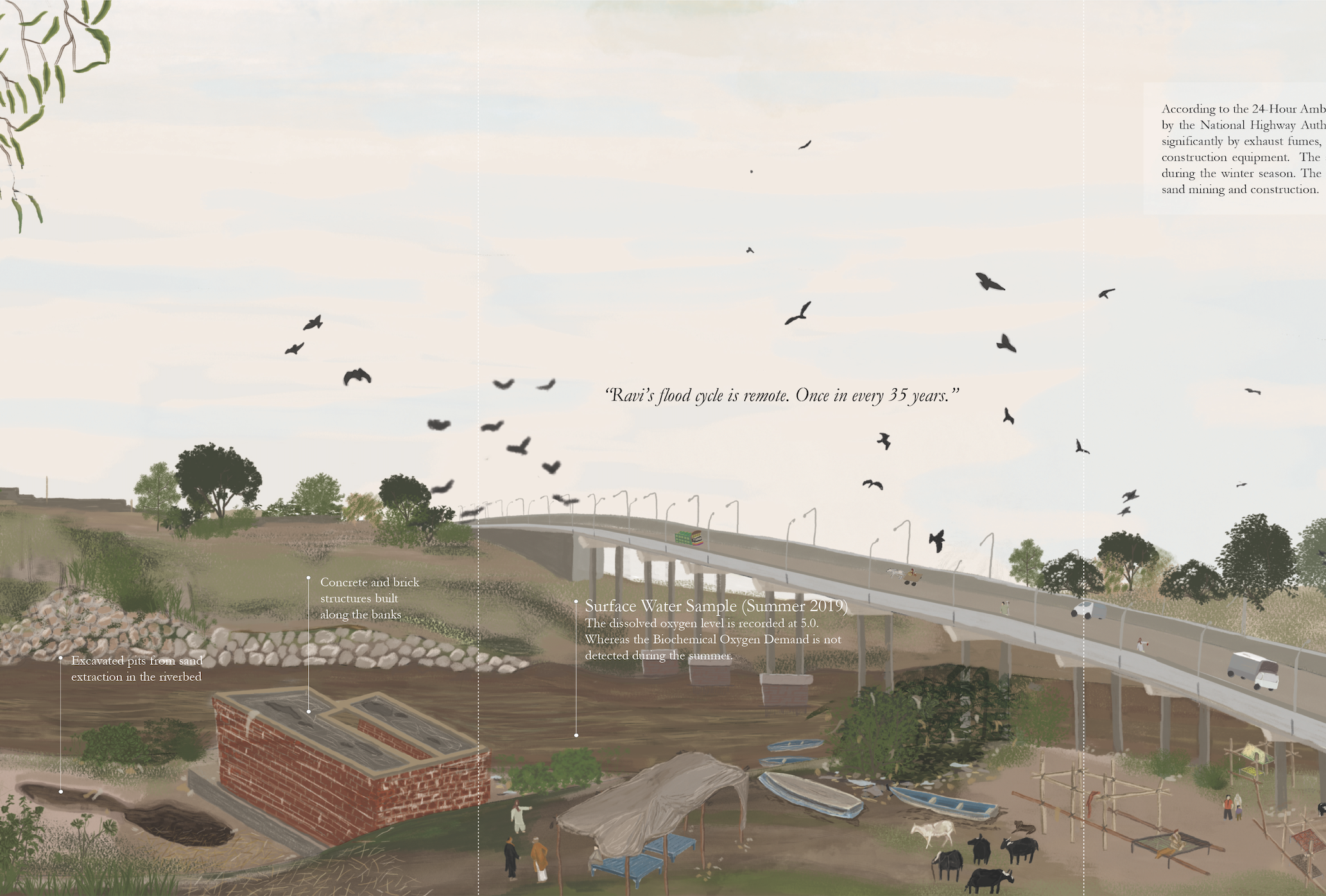
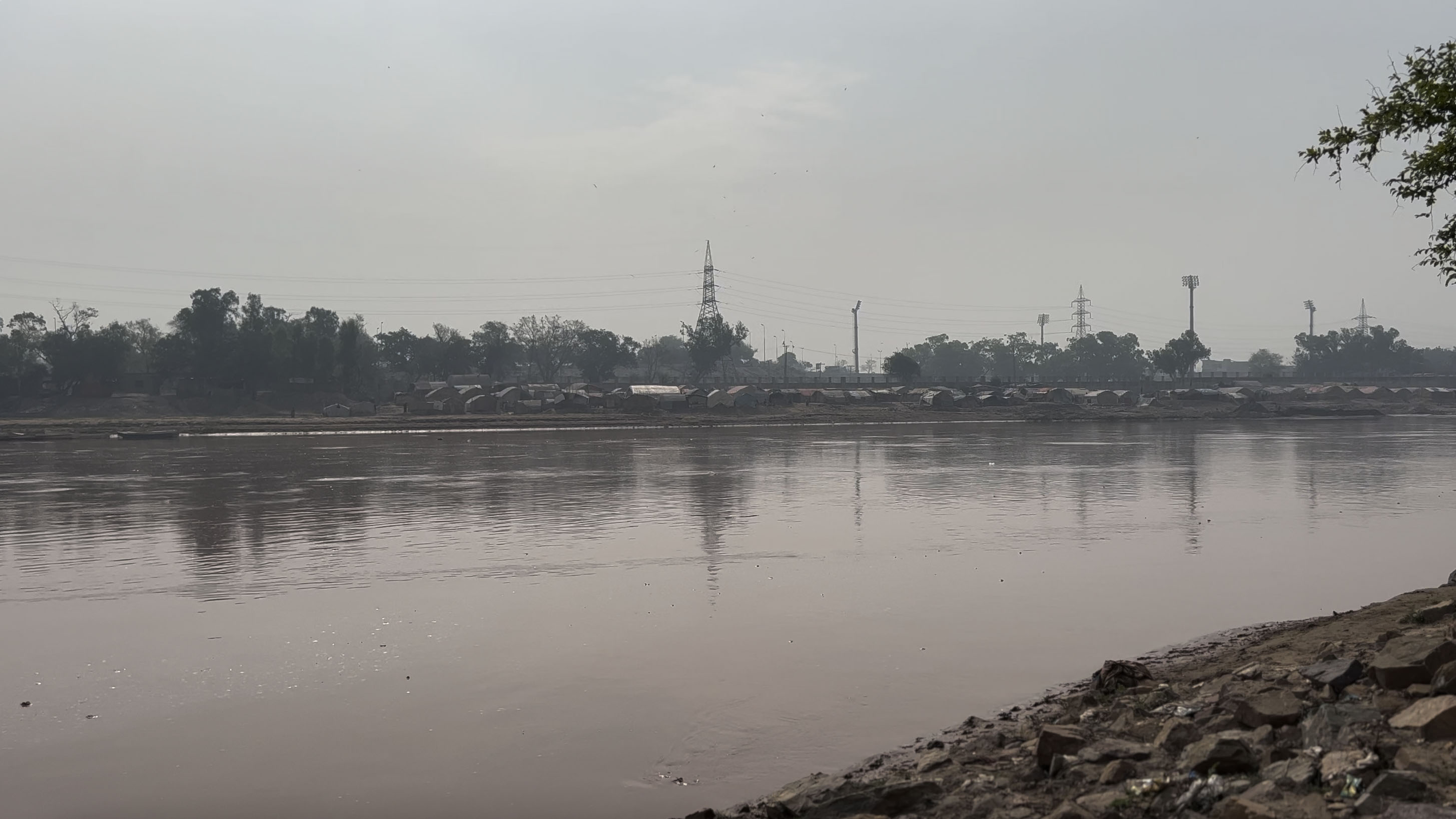
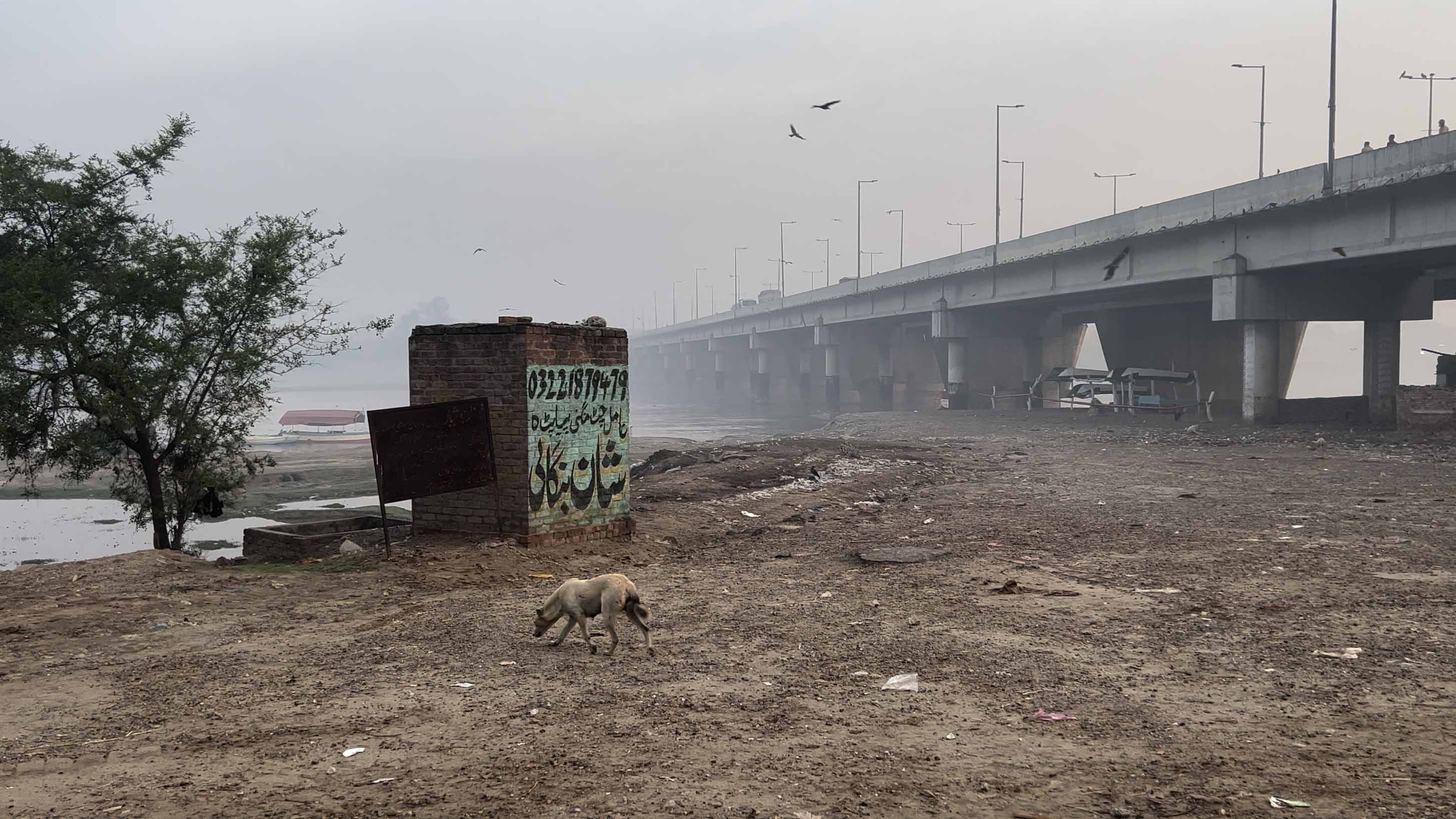
Tracing prominent infrastructures, human and non-human, as identified by locals within the interviews the drawing collects various interstitial networks that extend throughout the river. Disrupting the uniformity of scale, it gradually brings the viewer closer to the river’s edge, revealing the many nuances embedded within. This reading of the river’s current dilapidated state presents observations from community, layered with ecological and technical data revealing both the limitations and potentials for future interventions within the site. These ecological and lived dimensions of the river are inseparable from its hydraulic condition. Centering these situated understandings of the river as observed by its communities is an attempt to resist the exclusion foregrounded in RRUDP’s rendering. Any sanitization and concretization through development would entail forgetting and further severing the river Ravi and its heritage from the larger context.
Chronicles of Displacement
Living in temporary dwellings at the Lahore-Shahdara Ravi junction, approximately 350 dwellers actively shape the river’s edge through daily practices and rituals. During my conversations with Abdul Saboor, a local vendor living by the Ravi bank, raising a family with four young children reflected on how local media had ostracized their presence along the river Ravi. Showing me his vendor card as legitimate evidence of his lawful presence unprompted he said:
“Journalists and people from the media make their way into our dwellings, asking us all kinds of questions only to disparage us over the news. They call us criminals and drug addicts, but we have halal sources of income. We are daily wage workers. The local police in charge have all our records present, they have our identity information stored in their records, and no unauthorized individuals can enter these communities without permission or a background check.” – Interview with Dweller (2023)6
This framing was once again used to justify the proposed violence of the community’s displacement during my conversations with RRUDP affiliates where the dwellers were referred to as outcasts, vagrants, beggars and criminals. Capitalist real estate ventures and development discourse in the Global South, both from the top and often from the bottom, weaponizes such misrepresentation of marginalized communities to prioritize financial gain over social welfare. Such conversations with the local dwellers show how notions of social vagrancy and criminality shape governance mechanisms of control and surveillance. It is through such framings, that top-down organizations such as the Ravi Urban Development Authority (RUDA) brush aside criticism and concerns regarding the lack of resettlement proposals for marginalized communities living by the riverbanks. In rendering these communities as a burden on the societal system or as outcasts, the state implicitly justifies their temporal dwelling on government owned land as well as consequent displacement. The dwellers however do not choose to live in the hazardous environment of the floodplain, instead are victims of socio-political circumstances that force them into such conditions. Working as daily wage workers, fruit vendors, and even garbage collectors, they commute to and from the site daily to support their families.
In 2019, a local consulting firm Hagler Bailly in collaboration with the Asian Development Bank (ADB) proposed an alternate vision for the river’s future. Countering the lack of RRUDP’s social survey, their proposal was rooted in the in the river’s ecological revival and incorporated a resettlement scheme for the 350 dwellers residing on the riverbank. ADB’s proposal remained constrained in suggesting limited compensation for communities in a political economy with little precedent for successful resettlement.7 Out of the many living on site, only 123 households were deemed entitled to “vulnerable allowance,” “non-land assets,” and “resettlement assistance."8 The monetary compensation under “vulnerable allowance” was cited as 179.9 USD per household, barely accounting for basic needs in Pakistan’s inflated economy.
Moving beyond damaging misrepresentations of the river and communities, this case study brings attention to situated knowledge shared by those who embody the closest proximity to it. The challenges facing the Ravi require a comprehensive response that transcends traditional urban and hydrological frameworks. It calls for staging alternate encounters with the river that pieces together fragmented imaginaries, instead render the river as inseparable from its communities, the land and its histories.
Acknowledgements: This research has been supported by the MIT SA+P and the Aga Khan Program for Islamic Architecture Travel Grant 2023.
References
Akhter, Majed. 2015. “Infrastructure Nation: State Space, Hegemony, and Hydraulic Regionalism in Pakistan.” Antipode 47 (4): 849–70. (Akhter, 2015; Gilmartin, 2015; Hayat, 2024; Wescoat, 2025).
Dawn. 2021. "Remaking a River: Land and Profit Along the Ravi." By Fizzah Sajjad, Rafay Alam, et al. June 15, 2021. https://www.dawn.com/news/1629117/remaking-a-river-land-and-profit-along-the-ravi.
Engineering Consultancy Services Punjab (PVT.) Limited (ECSP). 2021. Environmental Impact Assessment (EIA) Report: River Ravi Training and Channelization Project (Phase 1). June 2021.
Hagler Bailly. 2020. TA-9463 PAK: Revitalizing the Ecosystem of Ravi River Basin Project Prefeasibility Report – Ravi Recreational Area at Shahdara.
Hagler Bailly. 2020. TA-9463 PAK: Revitalizing the Ecosystem of Ravi River Basin Health Impact Assessment Report.
Gilmartin, David. 2015. Blood and Water: The Indus River Basin in Modern History. 1 edition. University of California Press.
Hayat, Maira. 2024. “The Duty of Water: Land, Labour, and the Racialisation of Waste in Colonial and Contemporary Punjab.” Pt. 1329-1356. Antipode 56 (6).
Human Rights Watch. 2023. "Pakistan: Farmers Forcibly Evicted for Urban Project." April 11, 2023. https://www.hrw.org/news/2023/04/11/pakistan-farmers-forcibly-evicted-urban-project.
Lahore High Court. 2022. Public Interest Law Association of Pakistan vs. EPA etc. Writ Petition No. 9429 of 2021, Justice Shahid Karim. January 25.
Roy, Ananya. 2016. “Who's Afraid of Postcolonial Theory?” International Journal of Urban and Regional Research 40: 204.
Sinha, Amita and D. Fairchild Ruggles. 2004. “The Yamuna Riverfront, India: A Comparative Study of Islamic and Hindu Traditions in Cultural Landscapes.” Landscape Journal, Vol. 23, No. 2 (2004): 141-152.
Wescoat, James L. 2025. “The Making of a Hydro-Hazardscape: A Historical Geography of the Ravi River in Lahore.” In Living with Water. Routledge.
Notes
- The Ravi Urban Development Authority or RUDA has been appointed as the federal governing body of the river Ravi in Pakistan. Approved by the Pakistani federal authorities in 2019, this project is currently in its initial stages of construction. Interview with RUDA Stakeholders, August 2023.
- At the time this research was conducted in 2023, RUDA’s social survey had not yet begun. This date coincided with the groundbreaking of the project's first phase.
- Punj-aab, or five rivers refers to the Punjab region in the Indian subcontinent often described as the land of five rivers.
- During the nineteenth century, scroll paintings of the Ravi became a prominent colonial tool to stage the river and its surrounding landscape with intentionally controlled view. Two such paintings of the river were commissioned between 1840-45, prior to the annexation, featuring a view of the city surrounded by lush green fields and a wide channel of River Ravi surrounding the walled city. Another panorama following the same composition from 1860 featured an inscription, “Panoramic view of the city of Lahore,” where the river was confined to a narrow channel at the edge of the city. Distinct scripts were used to annotate both works highlighting potential differences in their intended audiences and raising the possibility that the earlier work inlaid with Persian inscriptions, was later reproduced for English audiences. Hazardous realities and implications of the active floodplain were washed away under blue glazes representing the river in these paintings currently on display in the Victoria and Albert Museum, in Stratford, London. Amita Sinha and D. Fairchild Ruggles reflect on this hegemonic vision captured in similar panoramas of the Yamuna River, where distant landscapes were often depicted with the absence of details integral to the understanding of its environment. For audiences across the ocean, these paintings depicted the promise of the Orient waiting to be explored, studied, and observed; the flattened nuances of dusty land and gleaming water would, however, erase the many narratives associated with the locals.
- RRUDP faced massive criticism from local activists, scholars, and members of the multiple communities inhabiting Ravi’s banks. Many cited concerns of increased environmental degradation, social disparity, displacement and unfair land acquisition. See Court Order Public Interest Law Association of Pakistan vs. EPA etc. (2021).
- “Halal” sources of income here is used in reference to earnings sourced through ethical means. Names of community members have been redacted for security concerns.
- Historically, within the context of Lahore, resettlement for marginalized communities has never been conducted successfully. In many cases proposal of resettlement often results in temporary displacement, only for communities to return to the land unless it’s consumed under a development project. The dwellers alongside River Ravi currently live on government-owned land, hence they have no form of ownership to their name.
- The social survey conducted by Hager Bailey identifies the cost of resettling communities living on the banks of Ravi to amount to 5.10 million USD. However, when divided amongst the individuals in one singular household, the compensation is not a sufficient incentive.
1 The Ravi Urban Development Authority or RUDA has been appointed as the federal governing body of the river Ravi in Pakistan. Approved by the Pakistani federal authorities in 2019, this project is currently in its initial stages of construction. Interview with RUDA Stakeholders, August 2023.
2 At the time this research was conducted in 2023, RUDA’s social survey had not yet begun. This date coincided with the groundbreaking of the project's first phase.
3 Punj-aab, or the land of five rivers refers to the Punjab region in the Indian subcontinent.
4 During the nineteenth century, scroll paintings of the Ravi became a prominent colonial tool to stage the river and its surrounding landscape with intentionally controlled view. Two such paintings of the river were commissioned between 1840-45, prior to the annexation, featuring a view of the city surrounded by lush green fields and a wide channel of River Ravi surrounding the walled city. Another panorama following the same composition from 1860 featured an inscription, “Panoramic view of the city of Lahore,” where the river was confined to a narrow channel at the edge of the city. Distinct scripts were used to annotate both works highlighting potential differences in their intended audiences and raising the possibility that the earlier work inlaid with Persian inscriptions, was later reproduced for English audiences. Hazardous realities and implications of the active floodplain were washed away under blue glazes representing the river in these paintings currently on display in the Victoria and Albert Museum, in Stratford, London.
Amita Sinha and D. Fairchild Ruggles reflect on this hegemonic vision captured in similar panoramas of the Yamuna River, where distant landscapes were often depicted with the absence of details integral to the understanding of its environment. For audiences across the ocean, these paintings depicted the promise of the Orient waiting to be explored, studied, and observed; the flattened nuances of dusty land and gleaming water would, however, erase the many narratives associated with the locals.
5 RRUDP faced massive criticism from local activists, scholars, and members of the multiple communities inhabiting Ravi’s banks. Many cited concerns of increased environmental degradation, social disparity, displacement and unfair land acquisition. See Court Order Public Interest Law Association of Pakistan vs. EPA etc. (2021).